
Finance and Accounting Articles – Blog Categories
Quick Summary
- Understand the foundational definition of financial acumen.
- Learn the core components and their significance in business.
- Discover practical steps to enhance your financial intelligence.
What is Financial Acumen? The Foundational Definition
Financial acumen refers to the ability to understand and apply financial principles in a way that enhances decision-making and drives business success. It encompasses a range of skills, including the ability to interpret financial statements, analyze financial data, and make informed decisions based on that analysis. Financial acumen is not just about numbers; it involves understanding the broader economic context in which a business operates and how financial decisions impact overall performance.
Core Components of Financial Acumen
To develop financial acumen, one must understand several core components:
* Financial Statements: Understanding balance sheets, income statements, and cash flow statements is fundamental. These documents provide insights into a company’s financial health and operational efficiency.
* Budgeting and Forecasting: The ability to create budgets and forecast future financial performance is essential for strategic planning and resource allocation.
* Cost Management: Knowing how to manage costs effectively can lead to improved profitability and operational efficiency.
* Investment Analysis: Evaluating potential investments and understanding their risks and returns is crucial for making sound financial decisions.
* Market Understanding: A grasp of market dynamics, including competition and economic trends, helps in making informed strategic choices.
Why is Financial Acumen Essential for Non-Finance Roles?
Financial acumen is not just for finance professionals; it is increasingly important for individuals in non-finance roles. Here’s why:
* Enhanced Decision-Making: Employees with financial acumen can make better decisions that align with the company’s financial goals.
* Cross-Functional Collaboration: Understanding financial implications fosters better communication and collaboration across departments.
* Career Advancement: Professionals who demonstrate financial acumen are often seen as more valuable and are more likely to be considered for leadership roles.
The Importance of Financial Acumen in the Workplace
In the workplace, financial acumen plays a vital role in:
* Strategic Planning: It aids in developing strategies that are financially viable and sustainable.
* Performance Measurement: Financial acumen allows for the assessment of business performance against financial goals.
* Risk Management: Understanding financial risks helps organizations mitigate potential losses and capitalize on opportunities.
The Core Distinction: Financial Acumen vs. Financial Literacy
While financial acumen and financial literacy are often used interchangeably, they are distinct concepts:
* Financial Acumen: Involves a deeper understanding of financial principles and their application in business decision-making.
* Financial Literacy: Refers to the basic understanding of financial concepts, such as budgeting and saving, which is essential for personal finance management.
How to Develop and Improve Financial Acumen
Improving your financial acumen requires a proactive approach:
* Education: Take courses in finance, accounting, or business management to build foundational knowledge.
* Practical Experience: Seek opportunities to work on financial projects or collaborate with finance teams.
* Mentorship: Find a mentor with strong financial expertise who can provide guidance and insights.
* Continuous Learning: Stay updated on financial trends and best practices through reading, webinars, and workshops.
Practical Steps to Build Financial Intelligence
To build your financial intelligence, consider the following practical steps:
1. Read Financial News: Stay informed about market trends and economic developments.
2. Analyze Financial Reports: Regularly review your organization’s financial statements to understand performance metrics.
3. Engage in Financial Discussions: Participate in discussions about financial strategies and outcomes with colleagues.
4. Utilize Financial Tools: Familiarize yourself with financial software and tools that can aid in analysis and reporting.
When is Financial Acumen Most Critical?
Financial acumen becomes particularly critical during:
* Budgeting Cycles: When planning for the upcoming fiscal year, understanding financial implications is essential.
* Mergers and Acquisitions: Evaluating potential deals requires strong financial analysis skills.
* Crisis Management: In times of financial distress, having a solid grasp of financial principles can guide recovery efforts.
| Feature | Financial Acumen | Financial Literacy |
|---|---|---|
| Definition | Ability to understand and apply financial principles | Basic understanding of financial terms and concepts |
| Application | Strategic decision-making and business insights | Personal finance management |
| Target Audience | Professionals in various roles | Individuals seeking basic financial knowledge |
Comparison of key aspects.
Critical Business Moments Requiring Strong Financial Acumen
Certain business moments demand heightened financial acumen:
* Launching New Products: Understanding the financial implications of product development and marketing is crucial.
* Entering New Markets: Financial analysis helps assess the viability and risks of expansion.
* Cost-Cutting Initiatives: Making informed decisions about where to cut costs without sacrificing quality requires financial insight.
Frequently Asked Questions (FAQ)
Q: Is financial acumen only for managers and executives?
Q: How can I measure my team’s financial acumen?
Q: Does financial acumen mean I need to become an accountant?
Q: What resources are available to improve financial acumen?
Q: How does financial acumen impact team collaboration?
Q: Can financial acumen be developed over time?
## Unlock Your Potential with LBTA
At LBTA, we understand the importance of financial acumen in today’s business landscape. Our comprehensive training programs are designed to equip professionals with the skills and knowledge necessary to excel in their roles. Whether you’re looking to enhance your financial understanding or develop your team’s capabilities, our expert-led courses provide the insights you need to succeed. Join us today and take the first step towards mastering financial acumen!
What Is Long-Term Financial Planning?
Before diving into the steps in long-term financial planning, it’s important to understand what the concept really means. Long-term financial planning is the process of setting and working toward financial goals that span years—or even decades. It’s about building a solid foundation for your future, not just managing your money today. Here’s what it typically involves:
Defining future financial goals: These could include retirement, children’s education, buying a home, or starting a business.
Projecting income and expenses: Estimating future earnings and costs to see what’s realistic and where adjustments are needed.
Creating a personalized investment strategy: Choosing savings and investment vehicles that match your risk tolerance and timeline.
Factoring in inflation and life changes: Planning for the unknown by considering rising costs and shifting priorities.
Reviewing and adjusting regularly: Like any plan, it needs to evolve with your life and financial situation.
Understanding this foundation makes it easier to follow the key steps in long-term financial planning that lead to financial security and peace of mind.
Why Long-Term Financial Planning Matters
Taking the time to understand the steps in long-term financial planning isn’t just smart—it’s essential. A well-thought-out plan gives you control, clarity, and confidence as you navigate life’s financial twists and turns. Here’s why long-term planning truly matters:
Financial Stability: It helps you prepare for major life events like retirement, education costs, or homeownership—without last-minute panic.
Smarter Decision-Making: You’re more likely to make informed, strategic choices rather than emotional or impulsive ones.
Wealth Building: Following the right steps in long-term financial planning allows your money to grow through smart saving and investing.
Emergency Readiness: With a long-term plan in place, you’re better equipped to handle job loss, health issues, or market downturns.
Peace of Mind: Simply put, knowing you’re working toward your future reduces stress and brings confidence to your daily life.
When you commit to the right financial planning steps, you’re not just preparing for the future—you’re shaping it on your terms.
Key Steps in Long-Term Financial Planning
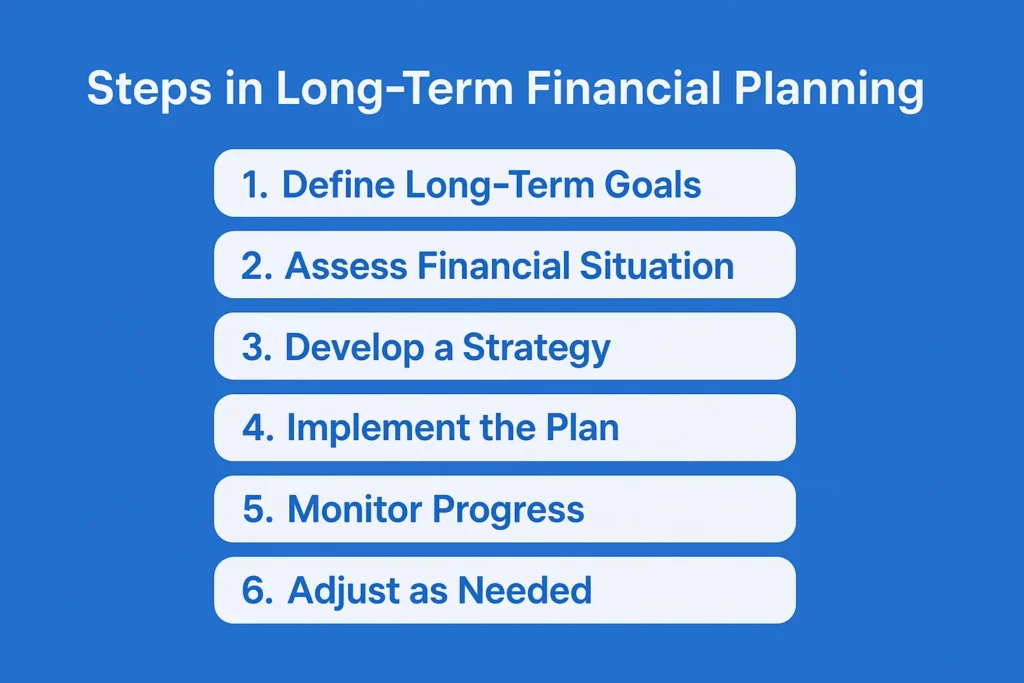
Getting your financial future on track starts with structure—and that’s where the steps in long-term financial planning come in. By following a clear, step-by-step approach, you’ll create a plan that adapts to life changes and helps you build lasting security. Let’s explore each step in detail:
1. Define Your Vision and Long-Term Goals
Every plan begins with a purpose.
Identify common goals like retirement, children’s education, or owning property.
Make each goal specific, measurable, and time-bound—for example, “Retire at 60 with $1 million in savings.”
2. Assess Your Current Financial Situation
You can’t move forward if you don’t know where you stand.
Evaluate your income, current savings, outstanding debts, and investments.
This creates your financial baseline, helping you spot strengths, gaps, and opportunities.
3. Estimate Future Needs and Expenses
Planning long-term means anticipating future costs.
Use retirement calculators, education cost estimates, and inflation projections to build realistic expectations.
Factor in your desired lifestyle, not just minimum survival needs.
4. Develop a Saving and Investment Strategy
Now it’s time to grow your wealth with intention.
Select the right mix of investment vehicles like mutual funds, stocks, or retirement accounts.
Balance risk and return based on your timeline—longer horizons can usually handle more risk.
5. Plan for Risk and Insurance Coverage
Protecting what you’ve built is just as important as growing it.
Ensure you have the right health, life, and disability insurance for your situation.
A good insurance strategy provides financial security against life’s unexpected events.
6. Create a Tax-Efficient Plan
Taxes can eat into your gains—unless you plan ahead.
Explore long-term tax strategies, such as capital gains management or charitable contributions.
Leverage retirement accounts and legal structures like trusts to optimize your tax position.
7. Review, Monitor, and Adjust Regularly
A financial plan isn’t static—it’s a living document.
Schedule annual reviews or updates after major life events (job change, marriage, new child).
Adjust your plan as income, expenses, and market conditions evolve.
By following these steps in long-term financial planning, you’ll build a strategy that’s not only smart—but sustainable for the life you’re working hard to create.
Read Also : Financial Planning Cycle: What It Is and Why It Matters in Today’s Economy
Mistakes to Avoid in Long-Term Planning
Even if you follow the right steps in long-term financial planning, a few common mistakes can still derail your progress. Being aware of these pitfalls helps you stay on track and make smarter decisions over time. Here are the most frequent mistakes—and how to avoid them:
Not Setting Clear Goals: Vague objectives lead to vague outcomes. Define specific, time-bound goals to guide your strategy.
Ignoring Inflation: Over decades, inflation can drastically reduce your purchasing power. Always factor it into your future cost estimates.
Underestimating Life Changes: Marriage, children, health issues, or career shifts can all impact your plan—so build in flexibility.
Focusing Only on Saving, Not Investing: Saving alone rarely beats inflation. Investing is essential to grow wealth over the long term.
Failing to Review Your Plan: A “set it and forget it” approach doesn’t work. Review your plan regularly to adjust for new goals or changes.
Avoiding these mistakes is just as important as following the correct steps in long-term financial planning—and can make the difference between drifting and achieving real financial security.
Read Also : Accounting and Finance for Managers: Essential Knowledge for Business Success
How Training Can Strengthen Your Long-Term Financial Skills
If you’re serious about mastering the steps in long-term financial planning, structured training can make a huge difference. Financial education gives you the tools, mindset, and confidence to make smarter decisions for the future. Here’s how training can help:
Clarifies Core Concepts: Training helps you fully understand budgeting, investing, risk management, and retirement planning.
Teaches Practical Tools: Learn how to use financial calculators, investment platforms, and tax planning apps effectively.
Improves Decision-Making: With expert insights, you’ll be able to assess options and avoid common financial mistakes.
Encourages Long-Term Thinking: Training shifts your mindset from short-term spending to long-term wealth building.
Boosts Confidence: The more you learn, the more confident you’ll feel in applying the steps in long-term financial planning to your personal or professional life.
Whether you’re just starting or refining your strategy, training turns guesswork into action—and knowledge into real results.
Read Also :The Ultimate Guide to Choosing the Best Finance Course for Career Success
Who Should Start Long-Term Financial Planning?
The truth is, anyone with financial goals can benefit from learning and applying the steps in long-term financial planning. Whether you’re just starting out or already mid-career, long-term planning helps you take control of your future. Here’s who should seriously consider starting now:
Young Professionals: The earlier you start, the more you benefit from compounding and smart goal-setting.
Families and Parents: Long-term planning helps prepare for education costs, homeownership, and family protection.
Freelancers and Business Owners: With unpredictable income, long-term planning offers structure and security.
Mid-Career Professionals: It’s the perfect time to assess retirement readiness and fine-tune financial strategies.
Anyone Nearing Retirement: Planning ahead ensures a smoother transition and better control over retirement income.
No matter your life stage, starting the steps in long-term financial planning today gives you more options and fewer regrets tomorrow.
Read Also : Financial Planning for an Individual: How to Build a Secure and Prosperous Future
Conclusion: Start Planning Today for the Life You Want Tomorrow
Taking action on the steps in long-term financial planning is one of the most empowering decisions you can make. From defining your goals and assessing your financial position to creating an investment strategy and reviewing your plan regularly, each step builds a foundation for lasting security and peace of mind.
The key is to start early and stay consistent. Your financial future doesn’t depend on how much you have today—it depends on the steps you take now to shape the life you want tomorrow.
Ready to secure your future? Enroll in our expert-led long-term financial planning course now!
LBTA is a globally recognized platform offering specialized programs designed to elevate both individual and corporate capabilities. Our services include:
General Training Programs in areas like finance, management, marketing, engineering, and human resources
Customized Training to address the specific challenges and goals of your organization
Research and Consulting services to help businesses optimize performance and make informed decisions
In-House Training delivered directly to your team, wherever you are
With active training centers in London, Dubai, Istanbul, Kuala Lumpur, and other global hubs, LBTA is your trusted partner in mastering the steps in long-term financial planning—and turning knowledge into lasting impact.
Read Also : How to Start Working Towards Personal Financial Planning: A Beginner’s Guide to Financial Freedom
FAQs
1. What are the key steps in long-term financial planning?
They include setting long-term goals, assessing your current finances, estimating future needs, creating an investment strategy, and reviewing your plan regularly.
2. When should I start long-term financial planning?
The best time to start is now—starting early gives you more time to grow your savings and prepare for future financial goals.
3. How often should I update my financial plan?
At least once a year, or whenever there are major life changes like a new job, marriage, or the birth of a child.
4. Do I need a financial advisor for long-term planning?
Not necessarily, but working with an advisor can provide personalized guidance, help avoid mistakes, and optimize your financial strategy.
5. What’s the difference between short-term and long-term financial planning?
Short-term planning focuses on immediate needs (0–3 years), while long-term planning targets goals 5 years or more into the future, like retirement or education.
What Is Personal Financial Planning?
Before diving into how to start working towards personal financial planning, it’s important to understand what it actually means. Personal financial planning is the process of managing your money to achieve specific life goals. It’s not just about saving—it’s about creating a strategy that works for your lifestyle. Here’s what it typically includes:
Setting Financial Goals: Identifying what you want to achieve financially—whether short-term (like paying off a credit card) or long-term (like buying a house or retiring).
Budgeting: Creating a plan for how you’ll earn, spend, and save money each month.
Managing Debt: Understanding your liabilities and using strategies to pay off loans efficiently.
Saving and Investing: Building an emergency fund, saving for big purchases, and growing wealth through investments.
Planning for the Future: Preparing for major life events such as education, marriage, or retirement with a clear roadmap.
Understanding these components is the first step in how to start working towards personal financial planning that truly supports your life and goals.
Read Also : Financial Planning for an Individual: How to Build a Secure and Prosperous Future
Why You Should Start Personal Financial Planning Today
If you’re asking yourself how to start working towards personal financial planning, the answer is simple—start now. The earlier you begin, the more control you have over your money, goals, and peace of mind. Here’s why taking action today makes a real difference:
Time Is Your Best Asset: The sooner you start, the more time you have to save, invest, and benefit from compound growth.
Reduces Financial Stress: Planning gives you a clearer picture of your finances, which helps you feel more in control and less anxious.
Prepares You for the Unexpected: Life is full of surprises—having a plan means you’re better equipped to handle emergencies or job changes.
Improves Your Spending Habits: When you plan, you become more intentional with your money and avoid unnecessary expenses.
Brings You Closer to Your Goals: Whether it’s buying a car, starting a business, or traveling the world, planning brings your goals within reach.
Learning how to start working towards personal financial planning today gives you a head start on a financially stable and secure tomorrow.
Read Also :The Ultimate Guide to Choosing the Best Finance Course for Career Success
Step-by-Step: How to Start Working Towards Personal Financial Planning
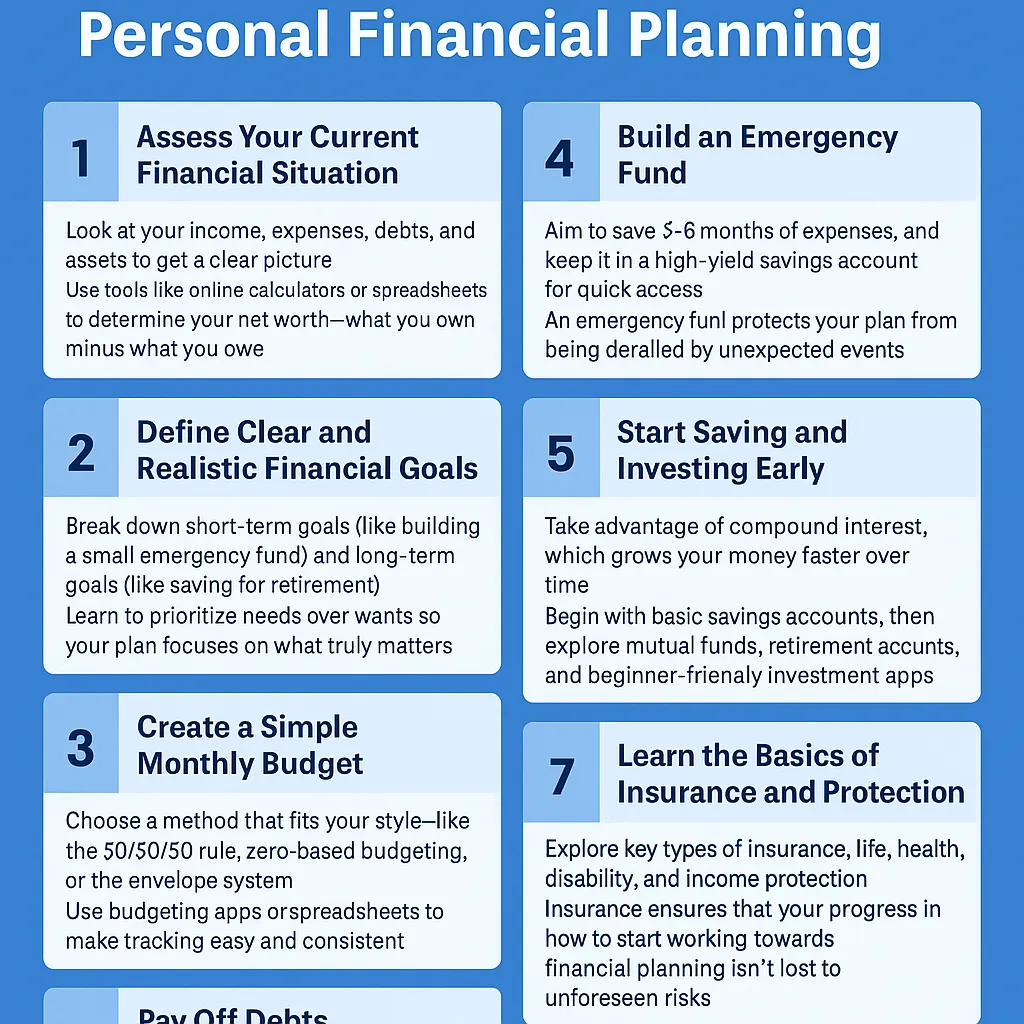
If you’re serious about gaining control of your money, this guide will walk you through exactly how to start working towards personal financial planning—one simple, practical step at a time. No jargon. No overwhelm. Just clear action.
1. Assess Your Current Financial Situation
The first step in how to start working towards personal financial planning is understanding where you stand financially.
Look at your income, expenses, debts, and assets to get a clear picture.
Use tools like online calculators or spreadsheets to determine your net worth—what you own minus what you owe.
2. Define Clear and Realistic Financial Goals
Next, clarify what you’re working toward.
Break down short-term goals (like building a small emergency fund) and long-term goals (like saving for retirement).
Learn to prioritize needs over wants so your plan focuses on what truly matters.
3. Create a Simple Monthly Budget
A budget is your financial roadmap.
Choose a method that fits your style—like the 50/30/20 rule, zero-based budgeting, or the envelope system.
Use budgeting apps or spreadsheets to make tracking easy and consistent.
4. Build an Emergency Fund
This is one of the most important steps in how to start working towards personal financial planning.
Aim to save 3–6 months of expenses, and keep it in a high-yield savings account for quick access.
An emergency fund protects your plan from being derailed by unexpected events.
5. Start Saving and Investing Early
You don’t need a lot to get started—you just need to start.
Take advantage of compound interest, which grows your money faster over time.
Begin with basic savings accounts, then explore mutual funds, retirement accounts, and beginner-friendly investment apps.
6. Pay Off Debts Strategically
Debt can slow down your progress if left unchecked.
Focus on high-interest debts first by understanding interest rates and repayment terms.
Consider strategies like the avalanche (highest interest first) or snowball (smallest balance first) methods.
7. Learn the Basics of Insurance and Protection
No financial plan is complete without protection.
Explore key types of insurance: life, health, disability, and income protection.
Insurance ensures that your progress in how to start working towards personal financial planning isn’t lost to unforeseen risks.
8. Review, Monitor, and Adjust
A financial plan is not a one-time document—it evolves.
Set monthly, quarterly, or annual review dates to track your progress.
Make changes as life evolves—new job, marriage, kids, or new goals.
Following these steps is the most practical way to succeed in how to start working towards personal financial planning—one action, one habit, one goal at a time.
Common Roadblocks and How to Overcome Them
Many people want to improve their finances but get stuck along the way. Understanding the most common obstacles—and how to deal with them—can make a big difference as you figure out how to start working towards personal financial planning. Here are some roadblocks to watch out for:
Lack of Knowledge: Not knowing where to begin can feel overwhelming. Start with basic resources or take a beginner-friendly course to build confidence.
Inconsistent Habits: Skipping budgets or ignoring spending limits disrupts your progress. Build small, daily habits that are easy to maintain.
Emotional Spending: Shopping under stress or boredom can sabotage goals. Track emotional triggers and set spending limits in advance.
Living Paycheck to Paycheck: With no room to save, it’s hard to plan ahead. Start by trimming unnecessary expenses and automating small savings.
Fear of Facing Reality: Avoiding your financial situation won’t make it better. Facing your numbers honestly is a bold first step in how to start working towards personal financial planning.
By recognizing these challenges early, you’ll be better equipped to stay motivated and make steady progress.
Read Also : Accounting and Finance for Managers: Essential Knowledge for Business Success
Why Take a Course on Personal Financial Planning?
If you’re unsure how to start working towards personal financial planning, taking a course can give you the structure, clarity, and confidence you need. It’s one of the smartest investments you can make—whether you’re just starting out or trying to fix past mistakes. Here’s why it’s worth it:
Guided Learning: A course walks you through each step in order, so you don’t feel lost or overwhelmed.
Practical Tools: You’ll learn how to use budgeting apps, investment calculators, and planning worksheets that make managing money easier.
Expert Advice: Courses are often taught by professionals who share real-world tips, not just textbook theory.
Accountability: Being in a structured environment motivates you to take action and follow through.
Long-Term Value: The skills you gain from learning how to start working towards personal financial planning will benefit you for the rest of your life.
Whether online or in-person, a course can help you stop guessing—and start building a financial future with purpose.
Read Also : Stages of Financial Planning Process: A Step-by-Step Guide to Smart Financial Management
Who Should Start Planning Now?
The truth is, there’s no “perfect time” to begin—everyone benefits from taking that first step. If you’re wondering how to start working towards personal financial planning, the answer is simple: start now, no matter your age or income. Here’s who should seriously consider getting started today:
Young Adults: Starting early builds strong money habits and allows compound interest to work in your favor.
New Graduates: Planning helps manage student loans, start saving, and avoid early financial mistakes.
Mid-Career Professionals: It’s the ideal time to fine-tune your goals, increase investments, and protect your family’s future.
Freelancers and Business Owners: Planning helps smooth out irregular income and ensures you’re covered during slow months.
Anyone Feeling Financially Uncertain: If you’re unsure where your money goes each month, it’s time to build a plan and take control.
No matter your starting point, learning how to start working towards personal financial planning now sets the foundation for financial peace of mind later.
Conclusion: Take the First Step Toward Financial Confidence
Now that you know how to start working towards personal financial planning, it’s time to take action. From assessing your current financial situation to setting goals, building a budget, saving, investing, and reviewing your progress—every step you take brings you closer to a future with less stress and more control.
You don’t need to have everything figured out today. What matters most is starting. The earlier you begin planning, the stronger your financial foundation will be—no matter your income or life stage.
Ready to start your journey? Join our personal financial planning course today!
LBTA is a global professional development provider offering a wide range of specialized programs designed to help individuals and organizations thrive. Our services include:
General Training Programs across finance, management, marketing, engineering, and HR
Customized Training built specifically around your goals and industry needs
Research and Consulting to support performance improvement and decision-making
In-House Training brought directly to your team, anywhere in the world
With locations in London, Dubai, Istanbul, Kuala Lumpur, and beyond, LBTA is your trusted partner in building real financial confidence—for life and for work.
Read Also : Financial Planning Cycle: What It Is and Why It Matters in Today’s Economy
FAQs
1. What is personal financial planning?
It’s the process of setting financial goals and creating a strategy to manage income, expenses, savings, and investments to achieve those goals.
2. How do I start working towards personal financial planning?
Begin by assessing your current finances, setting realistic goals, creating a monthly budget, and building an emergency fund.
3. Do I need a high income to start financial planning?
No. You can start at any income level. The key is to manage what you have wisely and build habits that support your goals.
4. How often should I review my financial plan?
At least once a year—or whenever a major life change occurs, like a new job, marriage, or having a child.
5. Can a financial planning course really help?
Yes. It provides structure, expert guidance, and practical tools to help you plan effectively and avoid common financial mistakes.
Quick Summary
- Understand the importance of financial planning.
- Learn key steps to create a personal financial plan.
- Avoid common mistakes and enhance decision-making.
Quick Summary
- Financial planning is essential for achieving personal financial goals.
- A structured approach helps in managing income, expenses, and investments.
- Regular monitoring and adjustments are key to staying on track.
What Is Financial Planning for an Individual?
Financial planning for an individual involves creating a comprehensive strategy to manage one’s finances effectively. This includes assessing current financial situations, setting future financial goals, and developing a roadmap to achieve those goals. It encompasses various aspects such as budgeting, saving, investing, and risk management. The ultimate aim is to ensure financial stability and growth over time.
Why Every Individual Needs a Financial Plan
Having a financial plan is crucial for several reasons:
- Goal Achievement: A financial plan helps individuals set and prioritize their financial goals, whether it’s buying a home, funding education, or planning for retirement.
- Financial Security: It provides a framework for managing risks and uncertainties, ensuring that individuals are prepared for unexpected expenses or economic downturns.
- Informed Decision-Making: A well-structured financial plan enables individuals to make informed decisions regarding investments, savings, and expenditures.
- Peace of Mind: Knowing that there is a plan in place can reduce stress and anxiety related to financial matters.
The Key Steps of Financial Planning for an Individual
Creating a financial plan involves several key steps:
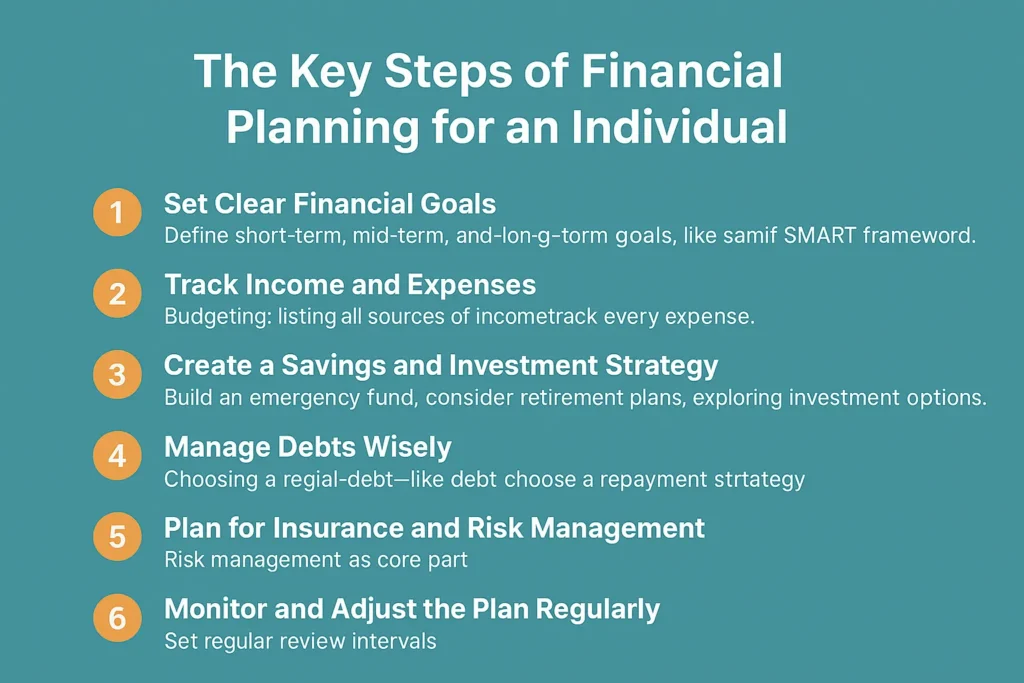
1. Set Clear Financial Goals
Setting clear, measurable, and achievable financial goals is the first step in financial planning. Goals can be short-term (e.g., saving for a vacation) or long-term (e.g., retirement savings). It’s essential to define these goals in specific terms:
- Short-term goals: Saving for a new car, paying off credit card debt.
- Medium-term goals: Saving for a home down payment, funding a child’s education.
- Long-term goals: Retirement savings, estate planning.
2. Track Income and Expenses
Understanding where your money comes from and where it goes is vital for effective financial planning. Tracking income and expenses helps individuals:
- Identify spending patterns.
- Recognize areas where they can cut back.
- Ensure they are living within their means.
Using budgeting tools or apps can simplify this process, making it easier to visualize financial health.
3. Create a Savings and Investment Strategy
A robust savings and investment strategy is essential for building wealth over time. This includes:
- Emergency Fund: Setting aside 3-6 months’ worth of living expenses for unexpected situations.
- Retirement Accounts: Contributing to retirement accounts like 401(k)s or IRAs to take advantage of tax benefits.
- Investment Portfolio: Diversifying investments across stocks, bonds, and other assets to balance risk and return.
4. Manage Debts Wisely
Debt management is a critical component of financial planning. Individuals should:
- Prioritize paying off high-interest debts first.
- Consider debt consolidation options if applicable.
- Avoid accumulating unnecessary debt by living within their means.
5. Plan for Insurance and Risk Management
Insurance is a vital part of financial planning, protecting individuals from unforeseen events. Key types of insurance to consider include:

- Health Insurance: To cover medical expenses.
- Life Insurance: To provide for dependents in case of untimely death.
- Disability Insurance: To protect income in case of illness or injury.
6. Monitor and Adjust the Plan Regularly
Financial planning is not a one-time event; it requires ongoing monitoring and adjustments. Individuals should:
- Review their financial plan at least annually.
- Adjust goals and strategies based on life changes (e.g., marriage, children, job changes).
- Stay informed about market trends and economic changes that may impact their financial situation.
Common Mistakes in Personal Financial Planning
Even with the best intentions, individuals often make mistakes in their financial planning. Common pitfalls include:
- Neglecting to Set Goals: Without clear goals, it’s challenging to create a focused financial plan.
- Ignoring Debt: Failing to address debt can hinder financial progress.
- Lack of Diversification: Putting all investments in one area increases risk.
- Not Reviewing Regularly: Failing to adjust the plan can lead to missed opportunities or increased risks.
How Training Can Improve Personal Financial Decision-Making
Investing in financial education can significantly enhance personal financial decision-making. Training programs can provide:
- Knowledge of Financial Concepts: Understanding key financial principles helps individuals make informed choices.
- Practical Skills: Learning how to create budgets, analyze investments, and manage debts effectively.
- Confidence: Gaining knowledge can empower individuals to take control of their financial futures.
Who Should Take a Financial Planning Course?
Financial planning courses are beneficial for:
- Young Professionals: Starting their financial journey and needing guidance.
- Families: Looking to manage household finances and plan for children’s education.
- Individuals Approaching Retirement: Seeking to optimize their retirement savings and income.
- Anyone Seeking Financial Literacy: Those who want to improve their understanding of personal finance.
Conclusion: Your Financial Future Starts with a Plan
In conclusion, mastering financial planning is essential for individuals looking to secure their financial future in 2026 and beyond. By setting clear goals, tracking finances, and continuously adjusting your plan, you can navigate the complexities of personal finance with confidence.
| Feature | Option A | Option B |
|---|---|---|
| Comprehensive Coverage | Yes | No |
| Personalized Strategy | Yes | Limited |
| Ongoing Support | Yes | No |
Comparison of key aspects.
Elevate Your Financial Knowledge with LBTA
At LBTA, we understand the importance of financial literacy in today’s world. Our comprehensive courses are designed to equip you with the knowledge and skills necessary to make informed financial decisions. Whether you are just starting your financial journey or looking to enhance your existing knowledge, our expert-led training can help you achieve your financial goals.
Frequently Asked Questions (FAQ)
Q: What is financial planning for individuals?
Q: Why is financial planning important for individuals?
Q: What are the key components of a financial plan?
Q: How can I start my financial planning journey?
Q: What tools can assist with financial planning for individuals?
Q: How often should I review my financial plan?
Quick Summary
- Understand the stages of the financial planning cycle.
- Learn the importance of structured financial planning.
- Discover how professional training can enhance your skills.
What Is the Financial Planning Cycle?
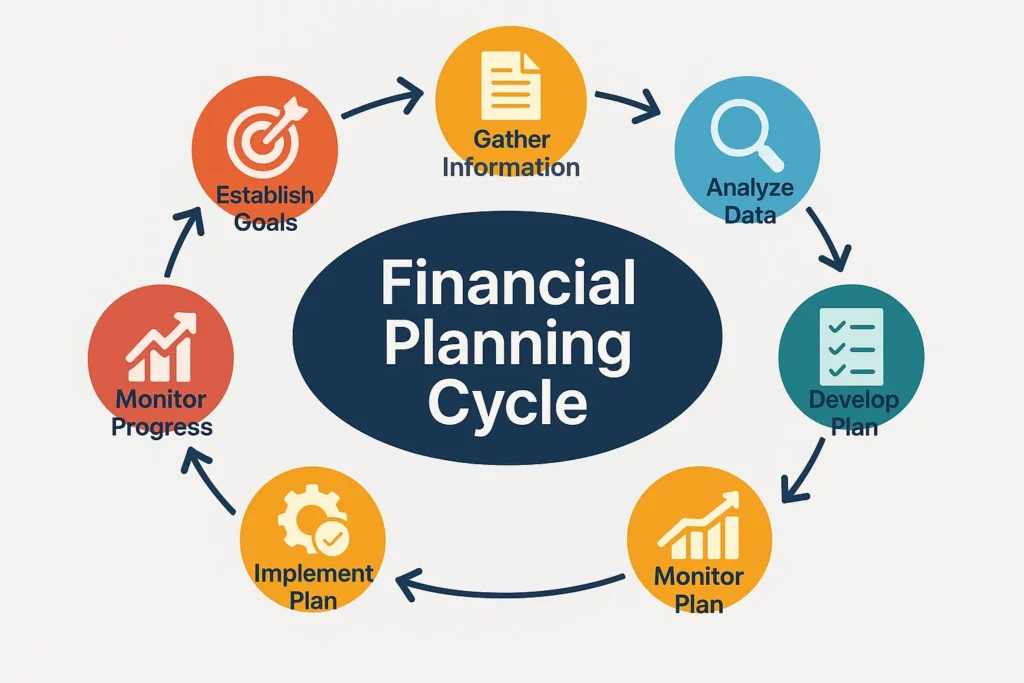
The financial planning cycle is a systematic process that helps individuals and organizations manage their finances effectively. It involves a series of steps that guide the planning, execution, and evaluation of financial strategies. The cycle is iterative, meaning that it is designed to be repeated as circumstances change and new goals are set. This approach ensures that financial plans remain relevant and effective over time.
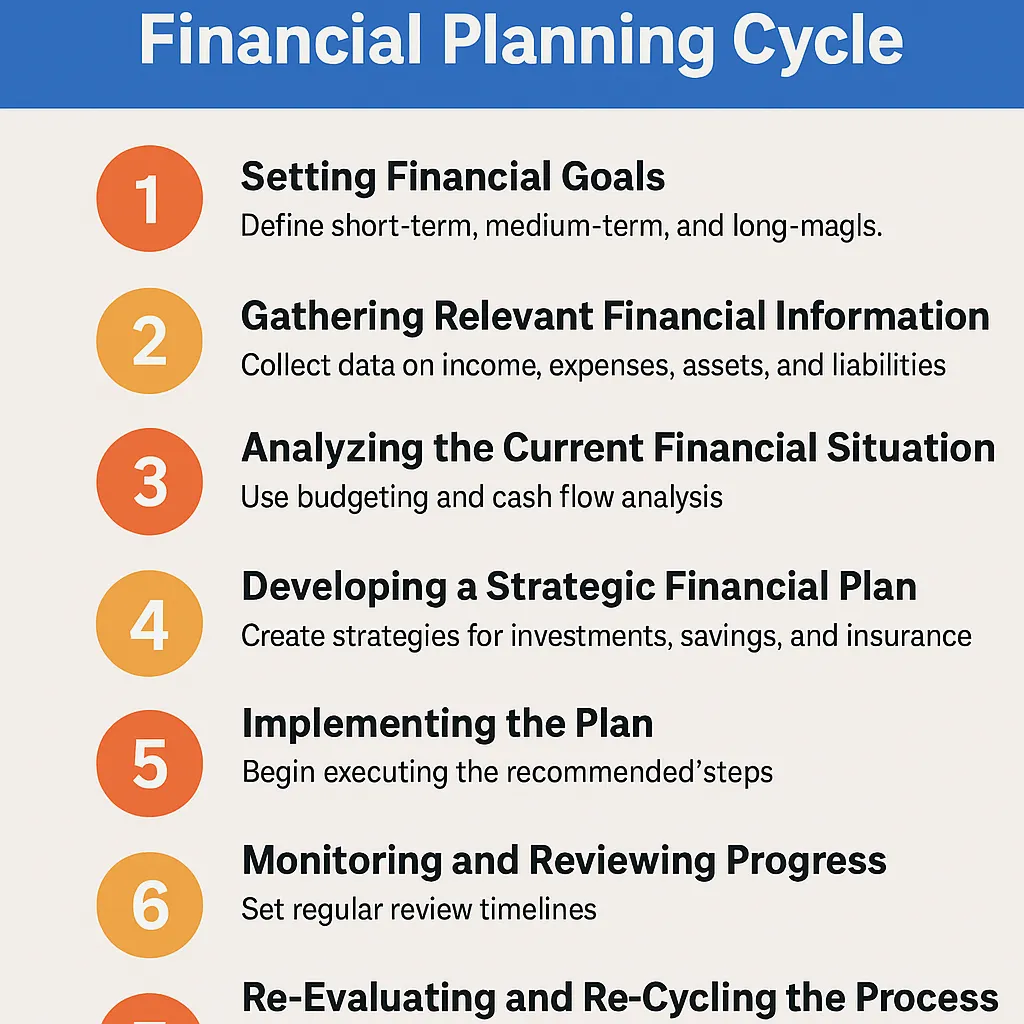
The financial planning cycle typically includes the following stages:
* Setting financial goals
* Gathering relevant financial information
* Analyzing the current financial situation
* Developing a strategic financial plan
* Implementing the plan
* Monitoring and reviewing progress
* Re-evaluating and re-cycling the process
Why Understanding the Financial Planning Cycle Is Crucial
Understanding the financial planning cycle is essential for several reasons:
* Adaptability: In a dynamic economic environment, having a structured approach allows for quick adjustments to financial plans as needed.
* Goal Achievement: A clear cycle helps in setting measurable and achievable financial goals, increasing the likelihood of success.
* Resource Allocation: It aids in the efficient allocation of resources, ensuring that funds are directed towards the most impactful areas.
* Risk Management: By continuously monitoring and reviewing financial plans, potential risks can be identified and mitigated early.
The Main Stages of the Financial Planning Cycle
1. Setting Financial Goals
Setting financial goals is the foundation of the financial planning cycle. Goals should be SMART: Specific, Measurable, Achievable, Relevant, and Time-bound. For instance, instead of saying, “I want to save money,” a SMART goal would be, “I want to save $10,000 for a home down payment within the next two years.” This clarity helps in formulating a focused financial strategy.
2. Gathering Relevant Financial Information
This stage involves collecting all necessary financial data, including income, expenses, assets, and liabilities. Tools like budgeting apps or financial spreadsheets can be beneficial in organizing this information. The more accurate and comprehensive the data, the better the analysis and planning will be.
3. Analyzing the Current Financial Situation
Once the data is gathered, the next step is to analyze it to understand the current financial position. This includes assessing cash flow, net worth, and debt levels. Financial ratios, such as the debt-to-income ratio, can provide insights into financial health. For example, a high debt-to-income ratio may indicate the need for debt reduction strategies.
4. Developing a Strategic Financial Plan
With a clear understanding of the current situation, the next step is to develop a strategic financial plan. This plan should outline how to achieve the set goals, including investment strategies, savings plans, and debt management. It’s essential to consider various scenarios and potential obstacles that may arise.
5. Implementing the Plan
Implementation is where the theoretical aspects of the financial plan become practical. This may involve setting up automatic transfers to savings accounts, investing in stocks or bonds, or adjusting spending habits. Effective implementation requires discipline and commitment to the plan.
6. Monitoring and Reviewing Progress
Regularly monitoring progress is crucial to ensure that the financial plan remains on track. This could involve monthly budget reviews or quarterly financial check-ins. Adjustments may be necessary based on changes in income, expenses, or financial goals.
7. Re-Evaluating and Re-Cycling the Process
The financial planning cycle is not a one-time event; it is an ongoing process. As life circumstances change—such as a new job, marriage, or retirement—financial goals may need to be re-evaluated. This stage involves revisiting the initial steps and making necessary adjustments to the financial plan.
Benefits of Following a Structured Financial Planning Cycle
- Clarity and Focus: A structured approach provides clarity on financial goals and the steps needed to achieve them.
- Improved Financial Health: Regular monitoring and adjustments can lead to better financial health and stability.
- Informed Decision-Making: A comprehensive understanding of one’s financial situation enables better decision-making regarding investments and expenditures.
- Long-Term Success: A continuous cycle of planning and re-evaluation fosters long-term financial success and security.
Common Pitfalls in Financial Planning Cycles (And How to Avoid Them)
While the financial planning cycle is a powerful tool, there are common pitfalls that can hinder success:
* Lack of Specificity: Vague goals can lead to unfocused planning. Ensure that all goals are specific and measurable.
* Ignoring Changes: Failing to adjust the plan in response to life changes can derail progress. Regular reviews are essential.
* Overcomplicating the Process: Keeping the planning process simple and straightforward can enhance adherence and effectiveness.
* Neglecting Professional Advice: Sometimes, seeking help from financial advisors can provide valuable insights and guidance.
How Professional Training Enhances Financial Planning Skills
Professional training in financial planning can significantly enhance one’s ability to navigate the financial planning cycle. Training programs often cover:
* Advanced Financial Concepts: Understanding complex financial instruments and strategies.
* Regulatory Knowledge: Staying updated on financial regulations and compliance requirements.
* Practical Applications: Learning through case studies and real-world scenarios to apply theoretical knowledge.
* Networking Opportunities: Connecting with other professionals in the field can provide support and resources.
Who Should Master the Financial Planning Cycle?
Mastering the financial planning cycle is beneficial for:
* Individuals: Anyone looking to improve their personal financial situation.
* Small Business Owners: Entrepreneurs who need to manage business finances effectively.
* Financial Advisors: Professionals seeking to enhance their service offerings to clients.
* Students: Those pursuing careers in finance or business management.
| Feature | Option A | Option B |
|---|---|---|
| Comprehensive Training | Yes | No |
| Practical Applications | High | Low |
| Expert Guidance | Available | Limited |
Comparison of key aspects.
Conclusion: Make Financial Planning a Repeatable Success
In conclusion, the financial planning cycle is an invaluable framework for achieving financial success. By understanding and implementing each stage of the cycle, individuals and businesses can navigate the complexities of financial management with confidence. Whether you are just starting your financial journey or looking to refine your existing strategies, embracing this cycle will lead to informed decisions and sustainable growth.
Frequently Asked Questions (FAQ)
Q: What is the Financial Planning Cycle?
Q: Why is the Financial Planning Cycle important?
Q: How often should I review my financial plan?
Q: Can the Financial Planning Cycle be used for both individuals and businesses?
Q: Do I need a financial advisor to go through the cycle?
Q: What are some common pitfalls in financial planning?
What Is Financial Planning and Why It Matters
Financial planning is the structured process of setting goals, assessing your financial situation, and creating a strategy to achieve lasting financial health. At the core of this approach are the stages of the financial planning process, which guide individuals and businesses from uncertainty to clarity. Here’s why it matters:
Goal Clarity: Financial planning helps you define short- and long-term goals—whether that’s buying a home, saving for education, or retiring comfortably.
Informed Decisions: With a structured process, you can make smarter choices around spending, saving, investing, and risk management.
Proactive Problem-Solving: Planning prepares you for life’s uncertainties, from market shifts to personal emergencies.
Long-Term Stability: By following the stages of the financial planning process, you stay focused, consistent, and confident in your financial journey.
In short, financial planning isn’t just about money—it’s about building a secure and purposeful future.
Overview of the Financial Planning Process
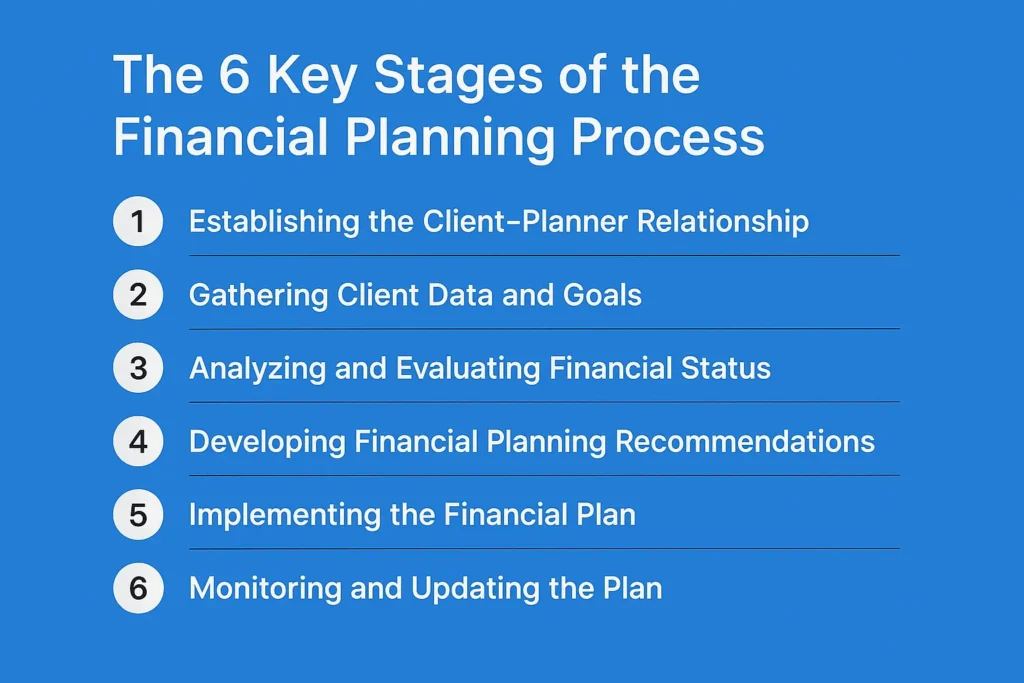
The journey to financial success is rarely a straight line—but with the right steps, it becomes much easier to navigate. The stages of the financial planning process provide a structured approach that helps individuals and businesses set goals, track progress, and adjust along the way. Typically, the process includes:
Establishing the Relationship – Setting expectations and defining the scope of the financial planning engagement.
Gathering Financial Data – Collecting details about income, expenses, assets, liabilities, and personal goals.
Analyzing the Information – Evaluating the current financial situation to identify strengths, weaknesses, and opportunities.
Developing Recommendations – Crafting a customized financial plan based on your needs, goals, and timeline.
Implementing the Plan – Putting the strategy into action through investments, budgeting, insurance, and other tools.
Monitoring and Updating – Reviewing and adjusting the plan regularly to stay on track and adapt to changes.
Understanding these stages of the financial planning process ensures you’re not just reacting to life—you’re leading it with intention.
Read Also : Accounting and Finance for Managers: Essential Knowledge for Business Success
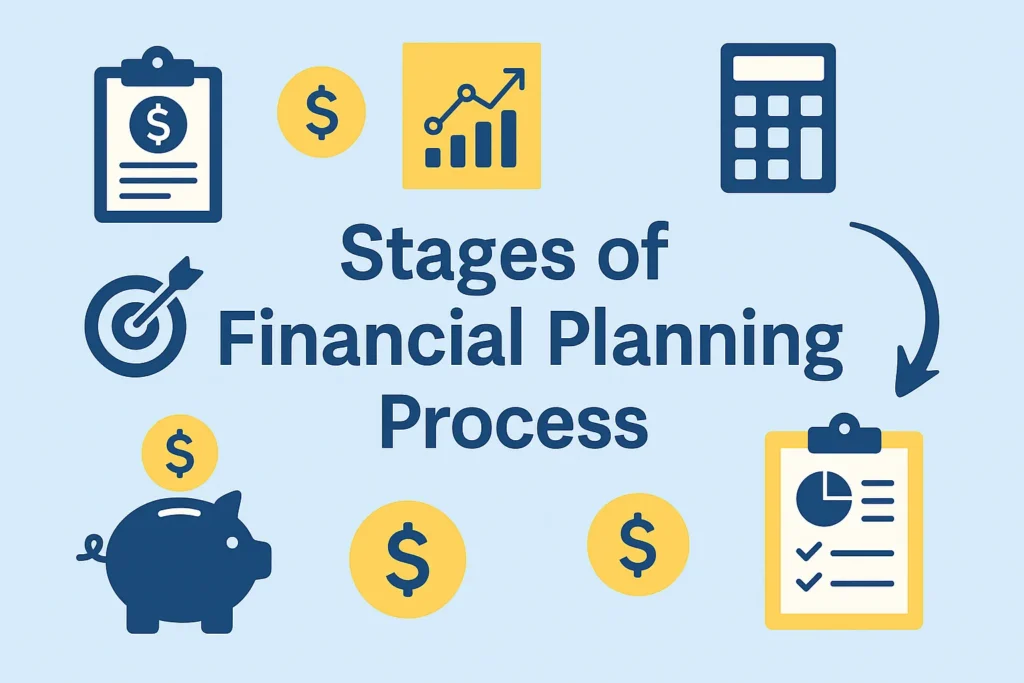
The 6 Key Stages of the Financial Planning Process
Financial planning isn’t a one-time task—it’s an ongoing journey. By understanding the stages of the financial planning process, individuals and businesses can make more informed decisions, stay focused on their goals, and adjust their course as life changes. Let’s explore each of the six key stages:
1. Establishing the Client–Planner Relationship
The first step in the stages of the financial planning process is all about trust and clarity.
Clarifying roles and responsibilities ensures both the planner and the client know what to expect from each other.
Setting communication expectations lays the foundation for a transparent, collaborative relationship.
2. Gathering Client Data and Goals
Good planning starts with good information.
Identifying financial objectives—like retirement, homeownership, or debt reduction—helps set the direction.
Collecting quantitative and qualitative data provides the planner with a complete picture of the client’s current situation.
3. Analyzing and Evaluating Financial Status
Now it’s time to crunch the numbers and look at the big picture.
Reviewing assets, liabilities, income, and expenses helps determine financial strengths and weaknesses.
Identifying gaps and opportunities allows for smarter strategy development and risk management.
4. Developing Financial Planning Recommendations
This stage turns insights into action.
Creating a tailored action plan ensures the client’s goals are addressed with clear, actionable steps.
Considering alternatives and trade-offs provides flexibility while keeping the strategy aligned with personal values.
5. Implementing the Financial Plan
Strategy means little without execution.
Coordinating with other professionals like tax advisors, insurance agents, or estate planners ensures the plan is comprehensive.
Assigning tasks and setting timelines helps bring the financial plan to life in a structured, realistic way.
6. Monitoring and Updating the Plan
The final (and ongoing) phase in the stages of the financial planning process is keeping the plan relevant.
Reviewing progress and adapting to life or market changes ensures the strategy evolves with the client’s needs.
Continuous improvement and recalibration help maintain alignment with long-term goals.
When all six stages are followed thoughtfully, financial planning becomes more than a service—it becomes a lifelong advantage.
Read Also :The Ultimate Guide to Choosing the Best Finance Course for Career Success
Common Mistakes to Avoid During the Financial Planning Process
Even with the best intentions, many people stumble along the stages of the financial planning process—and those mistakes can cost time, money, and peace of mind. Being aware of these common pitfalls can help you plan smarter and avoid costly setbacks:
Skipping Goal-Setting: Jumping into numbers without clearly defining your financial goals can lead to a plan that lacks direction and purpose.
Inaccurate or Incomplete Data: Providing outdated or partial financial information leads to poor analysis and unrealistic recommendations.
Failing to Revisit the Plan: A plan that isn’t reviewed regularly can quickly become irrelevant as your life or the market changes.
Overlooking Risk Management: Not accounting for insurance, emergency funds, or potential setbacks leaves you vulnerable in a crisis.
Trying to Do Everything Alone: Financial planning is complex—working with a professional ensures each stage is handled with care and expertise.
Emotional Decision-Making: Letting fear or excitement override logic can derail even the most well-thought-out plan.
Avoiding these common mistakes allows you to move through the stages of the financial planning process with more confidence, clarity, and long-term success.
Read Also :Essential Accounting Skills Needed for Success: A Comprehensive Guide
Why Training in Financial Planning Is a Game-Changer
Understanding the theory is one thing—applying it with confidence is another. That’s why professional training in financial planning can truly elevate your approach. Whether you’re a finance professional or simply managing your personal wealth, learning the stages of the financial planning process through expert-led training provides powerful advantages:
Structured Knowledge: Training breaks down each stage into clear, practical steps, making complex topics easier to understand and apply.
Real-World Application: Case studies and simulations help you practice what you learn, from goal-setting to risk analysis.
Updated Tools and Insights: Courses teach the latest strategies, software, and compliance standards shaping modern financial planning.
Greater Confidence: Knowing how to move through the process—professionally or personally—gives you the confidence to make informed decisions.
Career Advancement: For financial professionals, mastering the stages of the financial planning process through training adds value to your resume and credibility with clients.
Investing in training is more than education—it’s a leap toward smarter planning and long-term financial success.
Read Also :The Ultimate Guide to Choosing the Best Accounting Course for Your Career
Who Should Learn the Financial Planning Process?
The stages of the financial planning process aren’t just for financial advisors—they’re valuable for anyone who wants to take control of their financial future. Whether you’re managing a household budget or guiding corporate investments, understanding this process empowers better decisions. Here’s who can benefit most:
Individuals and Families: From saving for education to planning retirement, anyone with financial goals can benefit from a structured approach.
Young Professionals: Learning the stages early helps build healthy financial habits and long-term wealth.
Entrepreneurs and Business Owners: Financial planning supports smarter budgeting, forecasting, and sustainable business growth.
Finance and Accounting Professionals: Mastering the process enhances career opportunities and client trust.
HR and Compensation Specialists: Understanding financial planning helps in designing effective employee benefits and retirement packages.
Nonprofit Leaders and Trustees: Financial planning ensures proper fund allocation, compliance, and long-term impact.
No matter your role or background, gaining clarity on the stages of the financial planning process equips you with lifelong financial intelligence.
Conclusion: Master the Financial Planning Process and Take Control of Your Future
The stages of the financial planning process—from setting clear goals and analyzing financial data to implementing and adjusting your plan—form a reliable roadmap to financial clarity and long-term success. Whether you’re managing personal wealth or advising others, understanding these stages equips you to make smarter, more strategic decisions.
Financial planning isn’t something you do once—it’s a lifelong journey. The sooner you learn how to navigate it with confidence, the better prepared you’ll be to achieve your goals and overcome financial challenges.
Want to become a financial planning expert? Join our certified training programs today!
LBTA is a global professional development platform offering specialized programs tailored to both individuals and organizations. We provide:
General Training Programs in finance, management, marketing, engineering, and HR
Customized Training built around your unique needs and industry challenges
Research and Consulting to help organizations optimize performance
In-House Training delivered at your location, aligned with your schedule
With training centers in London, Dubai, Istanbul, Kuala Lumpur, and beyond, LBTA is your trusted partner for building expertise in every step of the financial planning journey.
Read Also :Financial Risk Management: A Comprehensive Guide to Protecting Your Finances
FAQs
1. What is the financial planning process?
It’s a structured approach to setting financial goals, analyzing your current situation, creating a plan, implementing it, and reviewing it regularly.
2. Why is financial planning important?
It helps individuals and businesses make informed financial decisions, reduce risks, and achieve long-term financial goals.
3. How often should I review my financial plan?
At least once a year or whenever a major life or financial event occurs—like marriage, a new job, or a market shift.
4. Can I create a financial plan without a professional?
Yes, but working with a certified planner ensures accuracy, strategy, and professional insight—especially for complex goals.
5. What is the first step in the financial planning process?
The first step is establishing a relationship with a financial planner, where roles, responsibilities, and expectations are clearly defined.
What Is Accounting and Finance for Managers?
If you’re in a leadership role, you’ve likely faced financial decisions—even without a background in finance. That’s exactly why Accounting and Finance for Managers is so important. This concept refers to the practical financial knowledge that managers need to effectively run teams, allocate resources, and contribute to strategic planning. Here’s what sets it apart:
Managerial Definition: Unlike traditional accounting, which focuses on preparing financial reports, Accounting and Finance for Managers is about interpreting those numbers to make smart business decisions.
Different from Specialist Roles: While accountants focus on compliance and finance teams manage investments or capital structure, managerial finance emphasizes how financial insights guide day-to-day operations and long-term planning.
Crucial for Non-Financial Managers: Even if you’re in HR, marketing, or operations, understanding key financial concepts helps you read budgets, justify spending, and align your work with broader business goals.
In short, Accounting and Finance for Managers equips leaders with the financial confidence they need to influence outcomes and drive results.
Why Every Manager Needs Financial Literacy
Being a great manager isn’t just about leading people—it’s also about understanding the financial impact of your decisions. That’s why Accounting and Finance for Managers is more than a nice-to-have; it’s a must-have skill in any industry. Here’s why financial literacy matters for every manager:
Better Budget Management: Managers who understand finance can plan, allocate, and monitor budgets more effectively—avoiding overspending and underperformance.
Stronger Strategic Thinking: Financially literate leaders make smarter choices because they understand how each decision affects the bottom line.
Improved Communication with Finance Teams: When managers speak the language of finance, collaboration with accountants, analysts, and executives becomes clearer and more productive.
Greater Accountability: Understanding key metrics allows managers to justify expenses, evaluate performance, and lead with data-driven confidence.
Incorporating Accounting and Finance for Managers into your leadership toolbox means you’re not just managing people—you’re managing results.
Read Also :The Ultimate Guide to Choosing the Best Finance Course for Career Success
Key Concepts Managers Should Know
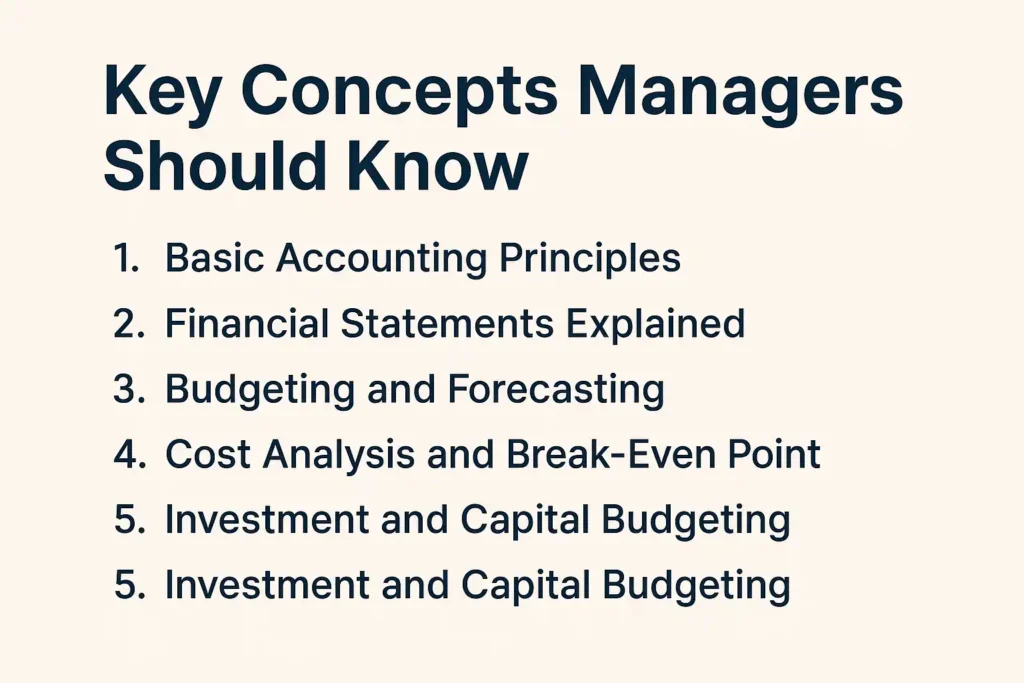
Understanding the core principles of finance empowers managers to lead with confidence and clarity. Whether you’re approving budgets, setting goals, or evaluating team performance, these five concepts form the foundation of effective decision-making in Accounting and Finance for Managers.
1. Basic Accounting Principles
At the heart of Accounting and Finance for Managers are the basic building blocks: assets, liabilities, equity, income, and expenses. These elements make up the financial DNA of any business. Managers should also be familiar with the accounting equation (Assets = Liabilities + Equity) and how double-entry bookkeeping ensures every transaction is balanced and accurately recorded. Understanding these fundamentals helps non-financial leaders speak the same language as accountants and make more informed decisions.
2. Financial Statements Explained
Every manager should be able to read and interpret the three primary financial statements:
The balance sheet shows a company’s financial position at a specific point in time.
The income statement reveals profitability over a set period by comparing revenue with expenses.
The cash flow statement tracks the movement of money in and out of the business.
In the context of Accounting and Finance for Managers, knowing how to analyze these reports allows leaders to spot trends, assess performance, and support strategic planning.
3. Budgeting and Forecasting
Budgeting isn’t just about keeping costs under control—it’s a strategic tool for managing resources and measuring progress. Accounting and Finance for Managers emphasizes the importance of comparing planned vs. actual performance, which helps identify gaps, opportunities, and necessary adjustments. Forecasting, on the other hand, enables managers to anticipate future outcomes and make proactive decisions that align with company goals.
4. Cost Analysis and Break-Even Point
Every manager should grasp the difference between fixed and variable costs, as well as how they impact pricing, profit margins, and scalability. In Accounting and Finance for Managers, understanding the break-even point is vital—it’s the moment where total revenue equals total costs, meaning your project or business becomes profitable. This knowledge supports smarter pricing strategies and better resource allocation.
5. Investment and Capital Budgeting
Managers often face choices between competing projects or investments. That’s where tools like Return on Investment (ROI), Payback Period, and Net Present Value (NPV) come into play. Within the scope of Accounting and Finance for Managers, these metrics help leaders evaluate potential returns, assess risk, and select the most value-driven initiatives—ensuring that every dollar invested moves the company forward.
How Accounting and Finance Support Managerial Decision-Making
Good decisions don’t happen by chance—they’re built on the right financial insights. That’s whyAccounting and Finance for Managersplays a vital role in supporting leadership across all departments. Here are some of the ways finance empowers better decision-making:
Budget Evaluation: Managers can assess if projects or departments are operating within budget, helping avoid overspending and improve cost control.
Performance Tracking: By reviewing financial reports, leaders can track progress, spot inefficiencies, and respond proactively to challenges.
Resource Allocation: Financial data helps determine where to invest time, money, and manpower for the greatest return.
Risk Assessment: Accounting tools reveal potential financial risks, enabling managers to plan and act with more caution and foresight.
Strategic Planning: Managers use financial projections and past performance to make informed decisions that align with business goals.
In the context of Accounting and Finance for Managers, these tools are more than just numbers—they’re the foundation for smarter, faster, and more strategic choices.
Read Also :Essential Accounting Skills Needed for Success: A Comprehensive Guide
Common Mistakes Non-Financial Managers Make
Even the most talented leaders can run into trouble when they overlook key financial principles. That’s why Accounting and Finance for Managers is so valuable—it helps prevent common mistakes that can harm performance and profitability. Here are some of the most frequent errors non-financial managers tend to make:
Ignoring Financial Reports: Many managers focus solely on operations, missing out on critical insights hidden in income statements and balance sheets.
Overestimating Budgets: Without financial context, managers may approve budgets that are unrealistic or misaligned with company goals.
Misjudging Profitability: Confusing revenue with profit is a costly mistake—true financial literacy helps managers understand margins and break-even points.
Failing to Monitor Cash Flow: Overlooking cash flow can lead to liquidity issues, even if the business appears profitable on paper.
Making Emotion-Driven Decisions: Without financial data, decisions may be based on instinct rather than facts—leading to poor outcomes.
By applying the principles of Accounting and Finance for Managers, leaders can avoid these pitfalls and lead with both confidence and clarity.
Read Also :The Ultimate Guide to Choosing the Best Accounting Course for Your Career
Learn Accounting and Finance for Managers Through Expert-Led Training
If you’re ready to turn financial understanding into a true leadership skill, Accounting and Finance for Managers training is the next step—and LBTAis here to help.
As a globally recognized platform, LBTA offers expert-led programs that equip professionals with the financial knowledge needed to make smarter, data-driven decisions. From general training in areas like finance, management, and marketing to customized solutions tailored to organizational goals, LBTA ensures every learning experience delivers real impact.
The platform also offers in-house training and consulting services for companies looking to build internal capabilities. With a presence in global business hubs like London, Dubai, Istanbul, and Kuala Lumpur, LBTA makes it easy to access world-class knowledge—wherever you are.
Conclusion: Gain Financial Confidence and Lead with Insight
In today’s results-driven workplace, understanding finance isn’t just for accountants—it’s a leadership skill. By learning the principles of Accounting and Finance for Managers, you’ll gain the confidence to read reports, manage budgets, and make decisions that align with your organization’s goals. Whether you’re leading a small team or managing a major department, financial literacy empowers you to lead with clarity, precision, and impact. Don’t just follow the numbers—understand them, and use them to shape your success.
Read Also :Financial Risk Management: A Comprehensive Guide to Protecting Your Finances
FAQs
What is an accounting and finance manager?
A professional who oversees budgeting, financial reporting, and accounting operations to support business strategy and compliance.
What is management accounting and finance?
It refers to using financial data to assist managers in planning, decision-making, and performance evaluation within an organization.
How do managers use financial accounting?
They use it to understand company performance, control budgets, assess profitability, and make informed strategic decisions.
What is meant by accounting for managers?
It’s the application of accounting principles to help managers interpret financial information and guide business decisions.
Is accounting manager higher than accountant?
Yes, an accounting manager typically supervises accountants and handles higher-level financial oversight and reporting.
Can an accountant be a financial manager?
Yes, with the right experience and skills, an accountant can transition into a financial management role.
Quick Summary
- Understand the importance of financial reporting.
- Learn key principles and common challenges.
- Discover best practices and benefits for professionals.
What Is Financial Reporting and Why It Matters
Financial reporting is the process of producing statements that disclose an organization’s financial status to management, investors, and the government. These reports are crucial for decision-making, as they provide a clear picture of a company’s financial health. Key documents in financial reporting include:
- Balance Sheet
- Income Statement
- Cash Flow Statement
- Statement of Changes in Equity
Understanding financial reporting is essential for several reasons:
- Transparency: It fosters trust among stakeholders by providing a clear view of financial performance.
- Compliance: Adhering to regulations and standards is critical for avoiding legal issues.
- Decision-Making: Accurate reports enable informed decisions that can drive business growth.
Key Principles of Effective Financial Reporting
To ensure that financial reports are effective, certain principles must be adhered to:
- Relevance: Information must be pertinent to the decision-making needs of users.
- Reliability: Reports should be accurate and free from bias.
- Comparability: Financial statements should be consistent over time, allowing for trend analysis.
- Understandability: Reports must be clear and concise, making them accessible to all stakeholders.
These principles help maintain the integrity of financial reporting and ensure that stakeholders can make informed decisions based on the data presented.
Common Challenges in Financial Reporting
Despite its importance, financial reporting comes with several challenges:
- Data Accuracy: Ensuring that all data is accurate and up-to-date can be difficult, especially in large organizations.
- Regulatory Compliance: Keeping up with changing regulations and standards can be overwhelming.
- Timeliness: Producing reports in a timely manner is crucial, yet often challenging due to data collection processes.
- Technology Integration: Many organizations struggle with integrating new technologies into their reporting processes.
Addressing these challenges requires a proactive approach, including investing in technology and training staff to enhance their skills.
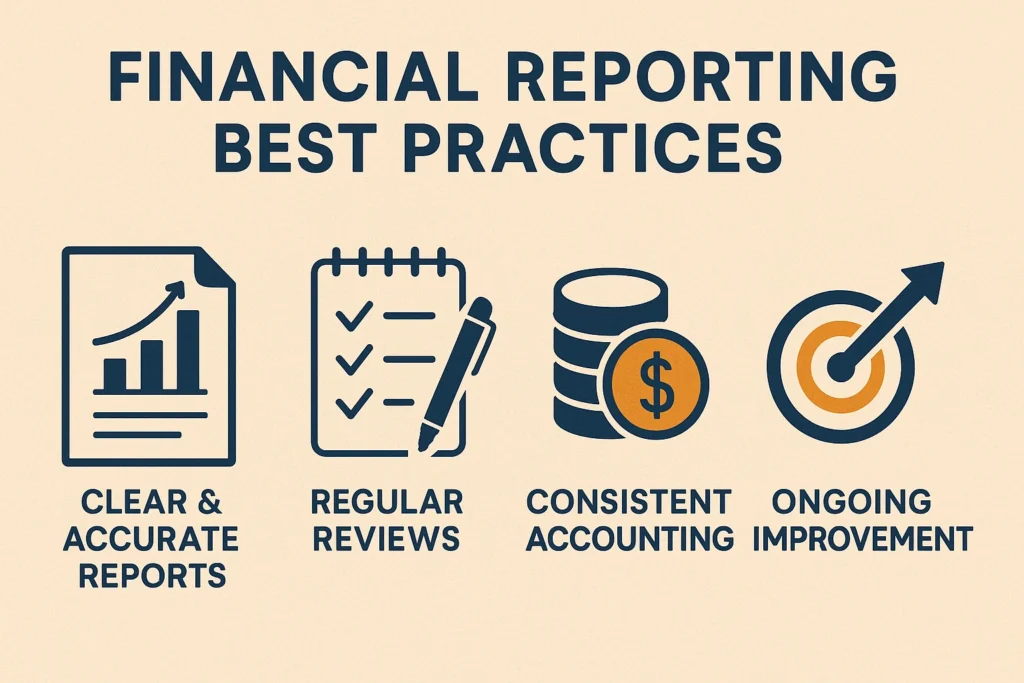
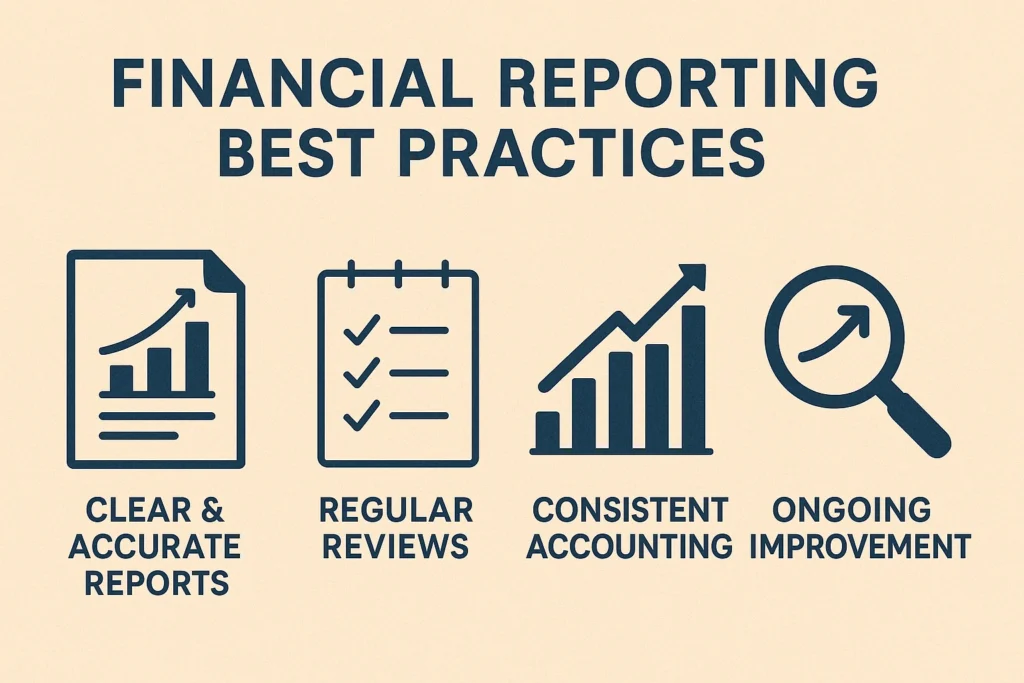
Financial Reporting Best Practices You Should Follow
Implementing best practices in financial reporting can significantly enhance the quality and reliability of your reports. Here are some best practices to consider:
- Automate Reporting Processes: Utilize software solutions to streamline data collection and reporting.
- Regular Training: Invest in ongoing training for your finance team to keep them updated on best practices and regulatory changes.
- Implement Internal Controls: Establish robust internal controls to ensure data integrity and compliance.
- Use Dashboards: Create visual dashboards for real-time insights into financial performance.
- Engage Stakeholders: Regularly communicate with stakeholders to understand their reporting needs and expectations.
By following these best practices, organizations can enhance the accuracy and effectiveness of their financial reporting.
Benefits of Following Financial Reporting Best Practices
Adopting best practices in financial reporting offers numerous benefits:
- Improved Decision-Making: Accurate and timely reports lead to better strategic decisions.
- Enhanced Credibility: Reliable financial reports build trust with investors and stakeholders.
- Increased Efficiency: Streamlined processes save time and reduce errors.
- Regulatory Compliance: Staying compliant with regulations minimizes the risk of penalties.
These benefits not only improve the financial health of an organization but also contribute to its overall success.
Learn and Apply Best Practices with Professional Training
To truly excel in financial reporting, professionals should consider enrolling in specialized training programs. LBTA offers comprehensive courses designed to equip finance professionals with the skills and knowledge necessary to implement best practices effectively. Our training covers:
- Advanced financial reporting techniques
- Regulatory compliance updates
- Data analysis and visualization tools
- Real-world case studies and applications
By participating in these training programs, professionals can enhance their expertise and drive their organizations toward financial excellence.
| Feature | Option A | Option B |
|---|---|---|
| Accuracy | High | Medium |
| Timeliness | Real-time | Monthly |
| Compliance | Full | Partial |
Comparison of key aspects.
Conclusion: Turn Financial Reporting Into a Strategic Advantage
In conclusion, mastering financial reporting is essential for professionals looking to make a significant impact in their organizations. By understanding the principles, overcoming challenges, and implementing best practices, you can transform financial reporting from a routine task into a strategic advantage. As we move through 2026, staying informed and skilled in financial reporting will be crucial for success in the competitive business landscape.
Frequently Asked Questions (FAQ)
Q: What are financial reporting best practices?
Q: Why are financial reporting best practices important?
Q: How can professionals implement financial reporting best practices?
Q: What role does technology play in financial reporting best practices?
Q: What are common challenges in adhering to financial reporting best practices?
Q: How often should companies review their financial reporting practices?
What is a Cash Flow Statement?
A Cash Flow Statement in Finance and Accounting is a financial report that tracks the movement of cash into and out of a business over a specific period. It provides a clear picture of a company’s liquidity, showing how well a business generates cash to fund operations, investments, and financial obligations.
Unlike income statements that focus on profitability, Cash Flow Statements in Finance and Accounting highlight a company’s actual cash position, making them essential for financial planning and decision-making.
Key Functions of a Cash Flow Statement in Finance and Accounting
 Monitors Liquidity: Ensures a business has enough cash to cover daily expenses.Tracks Cash Inflows and Outflows: Identifies how cash is generated and spent across operations, investments, and financing activities.Supports Financial Decision-Making: Helps businesses plan for expansion, debt repayment, and capital investments.Improves Investor and Lender Confidence: Provides transparency on cash management and financial stability.
Cash Flow Statement Formula
A standard Cash Flow Statement in Finance and Accounting follows this formula:
Net Cash Flow = Cash from Operating Activities + Cash from Investing Activities + Cash from Financing Activities
This formula ensures that all cash movements are accounted for, helping businesses maintain a balanced cash position.
Example of a Cash Flow Statement in Finance and Accounting
| Category | Amount ($) |
| Cash Flow from Operations | 50,000 |
| Cash Flow from Investing | (20,000) |
| Cash Flow from Financing | 30,000 |
| Net Cash Flow | 60,000 |
| Beginning Cash Balance | 40,000 |
| Ending Cash Balance | 100,000 |
In this example, the company generated $60,000 in net cash flow, increasing its total cash balance to $100,000.
A well-prepared Cash Flow Statement in Finance and Accounting helps businesses evaluate financial stability, plan for growth, and avoid cash shortages. The next section will explore the key components of a cash flow statement and their significance.
Key Components of a Cash Flow Statement
A Cash Flow Statement in Finance and Accounting consists of three main sections that track different types of cash movements within a business. These components help business owners, investors, and financial analysts understand how cash is generated and used over a specific period.
1. Cash Flow from Operating Activities
Represents cash generated or used in day-to-day business operations. Includes cash receipts from sales, payments to suppliers, employee wages, and tax payments. Positive operating cash flow indicates a company can sustain operations without external financing.
Example Transactions in Cash Flow from Operating Activities:
- Cash received from customers (+ $100,000)
- Salaries and wages paid (- $30,000)
- Rent and utilities paid (- $10,000)
- Taxes paid (- $5,000)
Net Cash from Operating Activities = $100,000 – ($30,000 + $10,000 + $5,000) = $55,000
Why It Matters:
A strong cash flow from operations indicates a business is profitable without relying on external financing.
2. Cash Flow from Investing Activities
Tracks cash spent on or earned from investments in long-term assets. Includes purchase or sale of property, equipment, and securities. Negative cash flow in this section is normal if a company is investing in growth.
Example Transactions in Cash Flow from Investing Activities:
- Purchase of new equipment (- $20,000)
- Sale of an old building (+ $50,000)
Net Cash from Investing Activities = $50,000 – $20,000 = $30,000
Why It Matters:
A company with high capital expenditures may be expanding operations, while a business selling assets may be trying to boost cash reserves.
3. Cash Flow from Financing Activities
Records cash transactions related to debt, equity, and dividends. Includes loan repayments, stock issuance, and dividend payments. Helps assess how a company raises and returns capital to investors and lenders.
Example Transactions in Cash Flow from Financing Activities:
- Loan received from a bank (+ $40,000)
- Loan repayment (- $20,000)
- Dividend payment to shareholders (- $10,000)
Net Cash from Financing Activities = ($40,000) – ($20,000 + $10,000) = $10,000
Why It Matters:
A business that frequently raises money from loans or investors may have higher financial risk, while consistent dividend payments indicate strong profitability.
4. Net Cash Flow and Ending Cash Balance
Net Cash Flow = Operating Cash Flow + Investing Cash Flow + Financing Cash Flow. The ending cash balance shows the total cash available at the end of the reporting period.
Example Calculation:
- Cash Flow from Operating Activities = $55,000
- Cash Flow from Investing Activities = $30,000
- Cash Flow from Financing Activities = $10,000
- Net Cash Flow = $55,000 + $30,000 + $10,000 = $95,000
- Beginning Cash Balance = $20,000
- Ending Cash Balance = $20,000 + $95,000 = $115,000
Why It Matters:
A positive net cash flow means a company has more cash coming in than going out, while a negative cash flow may indicate financial strain or growth investments.
Why Understanding These Components Matters?
Helps businesses track cash liquidity and financial stability. Supports investment and expansion decisions. Ensures companies can meet financial obligations without borrowing.
By analyzing the key components of a Cash Flow Statement in Finance and Accounting, businesses can optimize cash management strategies and improve financial performance. The next section will explore different types of cash flow statements and their applications.
Read Also : The Ultimate Guide to Choosing the Best Accounting Course for Your Career
Essential Accounting Skills Needed for Success: A Comprehensive Guide

Types of Cash Flow Statements
Different types of Cash Flow Statements in Finance and Accounting are used depending on a company’s reporting requirements, industry standards, and financial analysis goals. The two primary types of cash flow statements are direct and indirect methods, each offering a unique approach to tracking cash movement.
1. Direct Method Cash Flow Statement
Reports cash transactions directly, listing actual cash inflows and outflows. Provides a clear and detailed view of cash receipts and payments. Typically used by small businesses and companies with simple cash transactions.
Example Format (Direct Method):
| Category | Amount ($) |
| Operating Activities | |
| Cash received from customers | 200,000 |
| Cash paid to suppliers | (50,000) |
| Cash paid for salaries | (40,000) |
| Rent and utilities paid | (10,000) |
| Net Cash from Operations | 100,000 |
Pros:
- Shows actual cash transactions, making it easier to understand.
- Provides a real-time view of cash inflows and outflows.
 Cons:
Cons:
- Requires detailed tracking of all cash transactions.
- More difficult for companies with large and complex financial activities.
Best For:
- Small businesses, startups, and organizations that need a clear view of cash movements.
2. Indirect Method Cash Flow Statement
Starts with net income from the income statement and adjusts for non-cash transactions. Includes adjustments for depreciation, accounts receivable, and inventory changes. Used by large corporations and publicly traded companies due to its compliance with GAAP and IFRS.
Example Format (Indirect Method):
| Category | Amount ($) |
| Operating Activities | |
| Net income | 120,000 |
| Depreciation adjustment | 10,000 |
| Increase in accounts receivable | (15,000) |
| Increase in inventory | (5,000) |
| Net Cash from Operations | 110,000 |
Pros:
- Easier to prepare because it uses data from existing financial statements.
- Compliant with GAAP and IFRS, making it preferred for publicly traded companies.
Cons:
- Less transparency in actual cash transactions.
- Can be harder for non-financial professionals to interpret.
Best For:
- Large corporations, public companies, and organizations that follow GAAP or IFRS.
3. Comparative Cash Flow Statement
Presents cash flow data over multiple periods (e.g., year-over-year or quarter-over-quarter). Helps businesses identify trends in cash flow management. Used by investors, financial analysts, and management teams for performance evaluation.
Example: A company compares its Q1 2023 vs. Q1 2024 cash flow statements to see if cash inflows and outflows have improved.
| Category | Q1 2023 ($) | Q1 2024 ($) | Change (%) |
| Net Cash Flow | 80,000 | 100,000 | +25% |
| Cash from Operations | 50,000 | 70,000 | +40% |
| Cash from Investing | (30,000) | (20,000) | -33% |
Best For:
- Companies looking to analyze cash flow trends and long-term financial stability.
4. Pro Forma Cash Flow Statement
Used for financial forecasting and budgeting. Helps businesses predict future cash flows based on expected revenues and expenses. Commonly used for investor presentations, financial planning, and business expansion strategies.
Example: A startup creates a pro forma cash flow statement to estimate cash needs for the next 12 months before seeking funding.
Best For:
- Startups, businesses planning expansion or capital investments, and companies applying for loans.
Why Different Cash Flow Statement Types Matter?
Businesses choose a cash flow statement format based on their reporting needs, compliance requirements, and financial strategy. Investors and lenders analyze cash flow statements to assess a company’s financial health and risk level. Companies use comparative and pro forma cash flow statements to plan for future financial success.
By selecting the right Cash Flow Statement in Finance and Accounting, businesses can optimize financial decision-making and ensure strong liquidity management. The next section will explore how to prepare a cash flow statement step by step.
Read Also : The Complete Guide to Accounting: Types, Software, and Essential Skills
The Ultimate Guide to Choosing the Best Finance Course for Career Success
How to Prepare a Cash Flow Statement
Creating a Cash Flow Statement in Finance and Accounting requires a systematic approach to accurately track cash inflows and outflows. Whether using the direct or indirect method, the goal is to provide a clear picture of a company’s cash position for decision-making and financial planning. Below is a step-by-step guide on preparing a cash flow statement.
Step 1: Choose the Reporting Period
Determine the timeframe for the cash flow statement:
- Monthly – Helps in short-term cash management.
- Quarterly – Common for business performance reviews.
- Annually – Used for financial reporting and investor analysis.
Example: A business preparing a cash flow statement for Q1 2024 will track all cash transactions from January to March 2024.
Step 2: Gather Financial Data
Collect information from financial statements and accounting records, including:
- Income Statement: To retrieve net income.
- Balance Sheet: To track asset, liability, and equity changes.
- General Ledger: To find cash transactions such as loans, asset purchases, and payments.
Example: A retailer retrieves data on sales revenue, expenses, loan repayments, and inventory purchases for accurate cash tracking.
Step 3: Calculate Cash Flow from Operating Activities
Choose the method:
- Direct Method – Lists actual cash transactions.
- Indirect Method – Adjusts net income for non-cash items.
Direct Method Example:
| Operating Activities | Amount ($) |
| Cash received from customers | 200,000 |
| Cash paid to suppliers | (50,000) |
| Cash paid for salaries | (40,000) |
| Rent and utilities paid | (10,000) |
| Net Cash from Operations | 100,000 |
Indirect Method Example:
| Operating Activities | Amount ($) |
| Net Income | 120,000 |
| Add: Depreciation | 10,000 |
| Less: Increase in accounts receivable | (15,000) |
| Less: Increase in inventory | (5,000) |
| Net Cash from Operations | 110,000 |
Why It Matters:
- Positive operating cash flow → Indicates strong financial health.
- Negative operating cash flow → Signals potential liquidity issues.
Step 4: Determine Cash Flow from Investing Activities
Record cash spent on or earned from investments:
- Purchase or sale of equipment, property, or investments.
- Loans made to other businesses or received as repayments.
Example:
| Investing Activities | Amount ($) |
| Purchase of new equipment | (20,000) |
| Sale of an old building | 50,000 |
| Net Cash from Investing | 30,000 |
Why It Matters:
- Positive investing cash flow → Indicates asset sales or divestments.
- Negative investing cash flow → Often a sign of business growth and expansion.
Step 5: Calculate Cash Flow from Financing Activities
Record cash flow related to loans, equity, and dividend payments:
- Loan repayments or new borrowings.
- Stock issuance or buybacks.
- Dividend payments to shareholders.
Example:
| Financing Activities | Amount ($) |
| Loan received from a bank | 40,000 |
| Loan repayment | (20,000) |
| Dividend payments | (10,000) |
| Net Cash from Financing | 10,000 |
Why It Matters:
- Positive financing cash flow → Indicates new capital raised.
- Negative financing cash flow → Reflects debt repayments or dividends to investors.
Step 6: Compute Net Cash Flow and Ending Cash Balance
Use the cash flow formula:
Net Cash Flow = Cash from Operations + Cash from Investing + Cash from Financing
Final Calculation:
- Cash Flow from Operations = $110,000
- Cash Flow from Investing = $30,000
- Cash Flow from Financing = $10,000
- Net Cash Flow = $110,000 + $30,000 + $10,000 = $150,000
- Beginning Cash Balance = $50,000
- Ending Cash Balance = $50,000 + $150,000 = $200,000
Why It Matters:
- Positive net cash flow → Business is generating more cash than it spends.
- Negative net cash flow → Business may need to reassess cash management strategies.
Step 7: Review and Finalize the Cash Flow Statement
Ensure all data is accurate and aligns with income and balance sheet reports.Verify that all non-cash transactions (e.g., depreciation) are correctly adjusted.Use accounting software (SAP, QuickBooks, Xero) to automate cash flow calculations.
Example: A company conducts an internal audit and finds an omission in accounts payable, adjusting its cash flow statement before submission.
Why Properly Preparing a Cash Flow Statement Matters?
Tracks real cash movement, ensuring businesses can meet short-term obligations.Improves financial decision-making by showing how money is earned and spent.Ensures compliance with GAAP and IFRS accounting standards.
By following these step-by-step guidelines, businesses can create a comprehensive and accurate Cash Flow Statement in Finance and Accounting, ensuring financial stability and effective cash management. The next section will explore how businesses analyze cash flow statements for better financial decision-making.
Cash Flow Analysis for Financial Decision-Making
Analyzing a Cash Flow Statement in Finance and Accounting helps businesses assess financial health, liquidity, and operational efficiency. A well-structured cash flow analysis enables companies to manage cash effectively, reduce financial risk, and plan for growth. Below are key methods for analyzing cash flow to support strategic decision-making.
1. Liquidity Analysis: Evaluating a Company’s Ability to Cover Short-Term Obligations
Measures how well a business can meet short-term expenses and liabilities. Helps businesses determine if they need external financing or better cash management.
Key Liquidity Ratios:
- Current Ratio = Current Assets ÷ Current Liabilities
- Example: A business with $500,000 in current assets and $250,000 in current liabilities has a current ratio of 2.0, indicating strong liquidity.
- Cash Ratio = Cash & Cash Equivalents ÷ Current Liabilities
- Example: If cash and equivalents total $100,000 and liabilities are $200,000, the cash ratio is 0.5, meaning the company may struggle with short-term obligations.
Decision-Making Impact:
- A low cash ratio signals potential liquidity risks, prompting cost-cutting or financing options.
- A high cash ratio suggests excess cash reserves, which could be used for investments or growth.
2. Operating Cash Flow Analysis: Assessing Core Business Performance
Determines if a company’s core operations generate enough cash to sustain the business. Helps distinguish between a profitable business and one that is overly reliant on financing.
Operating Cash Flow Formula:
Operating Cash Flow = Net Income + Non-Cash Expenses + Changes in Working Capital
Example Calculation:
| Category | Amount ($) |
| Net Income | 200,000 |
| Add: Depreciation | 20,000 |
| Add: Increase in Accounts Payable | 10,000 |
| Less: Increase in Inventory | (15,000) |
| Net Operating Cash Flow | 215,000 |
Decision-Making Impact:
- A positive operating cash flow means the company generates sufficient cash from operations.
- A negative operating cash flow may indicate high expenses or declining revenue, requiring cost control measures.
3. Free Cash Flow (FCF) Analysis: Measuring Growth and Investment Potential
Identifies cash available after covering operating expenses and capital expenditures. Helps businesses plan for expansion, dividends, or debt reduction.
Free Cash Flow Formula:
FCF = Operating Cash Flow – Capital Expenditures
Example:
- Operating Cash Flow = $300,000
- Capital Expenditures (new equipment, buildings) = $100,000
- FCF = $300,000 – $100,000 = $200,000
Decision-Making Impact:
- A high FCF allows businesses to expand, pay dividends, or invest in growth.
- A low or negative FCF means the company may need external funding to sustain operations.
4. Cash Flow Margin Analysis: Evaluating Profitability and Efficiency
Measures how efficiently a company converts sales into cash. Helps businesses optimize pricing strategies and expense management.
Cash Flow Margin Formula:
Cash Flow Margin (%) = (Operating Cash Flow ÷ Net Sales) × 100
Example:
- Operating Cash Flow = $500,000
- Net Sales = $2,000,000
- Cash Flow Margin = (500,000 ÷ 2,000,000) × 100 = 25%
Decision-Making Impact:
- A higher cash flow margin indicates a company efficiently converts sales into cash.
- A low margin may suggest high operational costs or inefficient cash collection.
5. Cash Flow Trend Analysis: Identifying Patterns Over Time
Tracks historical cash flow trends to predict future financial performance. Helps businesses spot seasonal fluctuations and cash flow risks.
Example: Year-over-Year Cash Flow Comparison
| Category | 2022 ($) | 2023 ($) | Change (%) |
| Operating Cash Flow | 400,000 | 500,000 | +25% |
| Investing Cash Flow | (150,000) | (100,000) | -33% |
| Financing Cash Flow | 50,000 | (30,000) | -160% |
| Net Cash Flow | 300,000 | 370,000 | +23.3% |
Decision-Making Impact:
- Positive trends indicate business growth and strong financial management.
- Negative trends signal cash shortages, excessive debt, or declining profitability.
6. Industry Benchmarking: Comparing Cash Flow with Competitors
Helps businesses measure cash flow performance against industry standards. Identifies areas where a company outperforms or underperforms competitors.
Example: Cash Flow Margin by Industry
| Industry | Average Cash Flow Margin (%) |
| Tech Sector | 30% |
| Retail Sector | 15% |
| Manufacturing | 20% |
Decision-Making Impact:
- A company below the industry benchmark should optimize costs, revenue collection, or pricing strategies.
- A higher cash flow margin than competitors signals strong financial health and efficiency.
Why Cash Flow Analysis is Essential for Decision-Making?
Helps businesses manage liquidity and avoid cash shortages.Guides investment, expansion, and financing decisions.Provides early warning signs of financial instability.Improves profitability by optimizing operational cash flow.
By mastering Cash Flow Analysis in Finance and Accounting, businesses can **improve financial planning, enhance profitability
Read Also :Essential Skills for Finance Jobs: A Comprehensive Guide for Success
The Ultimate Guide to Finance: Key Concepts, Tips, and Strategies
Common Mistakes in Cash Flow Statements and How to Avoid Them
A Cash Flow Statement in Finance and Accounting is a critical financial document, but errors in its preparation can misrepresent a company’s liquidity and financial health. Identifying and correcting these mistakes ensures accurate reporting, better cash management, and informed decision-making. Below are common cash flow statement errors and how to avoid them.
1. Misclassifying Cash Flows
Mistake: Recording cash flows under the wrong category (Operating, Investing, or Financing).How to Avoid It:
- Follow GAAP or IFRS guidelines for proper classification.
- Operating activities → Day-to-day transactions (revenue, wages, taxes).
- Investing activities → Asset purchases, sales, and capital expenditures.
- Financing activities → Loans, debt repayments, stock issuance, and dividends.
Example: If a business records a loan repayment under operating cash flow instead of financing, it distorts the company’s real operational cash flow.
2. Ignoring Non-Cash Expenses
Mistake: Forgetting to adjust for non-cash expenses like depreciation and amortization in the indirect method.How to Avoid It:
- Add back depreciation and amortization when using the indirect method.
- Cross-check with the income statement to ensure all non-cash adjustments are accounted for.
Example: A company reports $100,000 in net income but forgets to add $20,000 in depreciation, understating cash flow.
3. Overlooking Changes in Working Capital
Mistake: Not adjusting for changes in accounts receivable, inventory, or accounts payable.How to Avoid It:
- Track increases or decreases in current assets and liabilities.
- Increase in accounts receivable → Decrease in cash flow (money not yet received).
- Decrease in accounts payable → Decrease in cash flow (outstanding bills paid).
Example: A company with $50,000 in new accounts receivable but not adjusting for it overstates cash flow from operations.
4. Misreporting Loan Transactions
Mistake: Including loan repayments in operating cash flow instead of financing activities.How to Avoid It:
- Loan proceeds → Financing inflow.
- Loan repayments → Financing outflow.
Example: A business receives a $100,000 loan but mistakenly includes it as operating cash inflow instead of financing, distorting the company’s cash-generating ability.
5. Forgetting to Record Interest and Dividends Correctly
Mistake: Misclassifying interest payments, dividends paid, or dividends received.How to Avoid It:
- Interest paid → Operating cash flow (GAAP) or financing (IFRS).
- Dividends paid → Financing cash flow.
- Dividends received → Operating cash flow (GAAP) or investing (IFRS).
Example: A company pays $10,000 in dividends but mistakenly records it under operating activities instead of financing.
6. Not Reconciling with the Balance Sheet and Income Statement
Mistake: The cash flow statement doesn’t align with balance sheet and income statement data.How to Avoid It:
- Cross-check beginning and ending cash balances with the balance sheet.
- Ensure net income matches the income statement before adjustments.
Example: A company shows $200,000 in cash flow from operations but has a lower cash balance on the balance sheet, signaling missing transactions.
7. Using the Wrong Method (Direct vs. Indirect) Incorrectly
Mistake: Mixing direct and indirect methods within the same statement.How to Avoid It:
- Use only one method for calculating operating cash flow:
- Direct Method → Lists actual cash transactions.
- Indirect Method → Starts with net income and adjusts for non-cash expenses.
Example: A company using the indirect method should not list cash received from customers, as this is part of the direct method.
8. Not Updating for Accrual Adjustments
Mistake: Reporting revenue or expenses based on accrual accounting without adjusting for actual cash received or paid.How to Avoid It:
- Recognize revenue only when cash is received, not when invoiced.
- Adjust for prepaid expenses, deferred revenue, and unearned income.
Example: A company records $80,000 in revenue but hasn’t received payment yet, inflating its cash flow.
9. Ignoring Currency Exchange Rate Adjustments (For Multinational Companies)
Mistake: Not adjusting cash flow for foreign currency exchange rate fluctuations.How to Avoid It:
- Report foreign exchange gains or losses separately in cash flow statements.
- Recalculate cash balances based on current exchange rates.
Example: A U.S.-based company with European operations may see cash flow variations due to fluctuations in the Euro-to-USD exchange rate.
10. Not Reviewing and Auditing the Cash Flow Statement
Mistake: Failing to review for errors before finalizing financial statements.How to Avoid It:
- Use accounting software (QuickBooks, SAP, Oracle NetSuite) to automate calculations.
- Conduct internal reviews and external audits before publishing financial reports.
Example: A business identifies a $5,000 discrepancy in cash flow during an internal audit and corrects the report before submission.
Why Avoiding These Mistakes Matters?
Ensures accurate financial reporting and compliance with GAAP/IFRS. Helps businesses improve cash flow management and strategic planning. Builds investor and stakeholder confidence in a company’s financial stability.
By eliminating these common cash flow statement errors, businesses can enhance financial transparency, optimize liquidity, and make informed investment decisions. The next section will explore how professionals can master cash flow statement preparation and analysis with expert guidance.

Cash Flow Statements and Compliance with Financial Standards
Ensuring that Cash Flow Statements in Finance and Accounting comply with financial standards is crucial for accuracy, transparency, and regulatory adherence. Businesses must follow GAAP (Generally Accepted Accounting Principles) or IFRS (International Financial Reporting Standards) to produce reliable financial reports that meet investor, regulatory, and internal decision-making requirements.
1. Importance of Compliance in Cash Flow Statements
Ensures financial accuracy – Prevents misreporting that could lead to audits, fines, or legal issues.Builds investor and stakeholder trust – Provides a clear picture of a company’s liquidity and financial health.Meets regulatory requirements – Helps businesses comply with SEC (U.S.), FASB, IASB, and tax authorities.Facilitates financial comparisons – Ensures consistency, allowing benchmarking with industry peers.
Example: A publicly traded company must file quarterly and annual cash flow statements with the SEC under GAAP guidelines.
2. Key Financial Standards Governing Cash Flow Statements
Different accounting frameworks regulate how businesses prepare and report cash flow statements.
GAAP (Generally Accepted Accounting Principles) – U.S. Standard
- Requires the indirect method for operating cash flow (direct method is optional).
- Focuses on accrual-based reporting, ensuring adjustments for non-cash transactions.
- Mandates classification of interest paid/received under operating activities.
Example: A U.S. company reports loan interest payments under operating cash flow in compliance with GAAP.
IFRS (International Financial Reporting Standards) – Global Standard
- Allows companies to use either direct or indirect method for operating cash flow.
- Requires classifying interest and dividends based on economic substance:
- Interest Paid → Can be classified as operating or financing.
- Interest Received → Can be classified as operating or investing.
- Dividends Paid → Classified as financing.
- Dividends Received → Classified as operating or investing.
Example: A European firm classifies interest received under investing cash flow, following IFRS flexibility.
IAS 7 (International Accounting Standard 7) – IFRS Standard for Cash Flow Statements
- Requires companies to disclose changes in cash and cash equivalents.
- Encourages the direct method for clarity but permits the indirect method.
- Ensures disclosure of non-cash transactions separately (e.g., asset purchases through financing).
Example: A multinational company reports lease transactions as non-cash financing activities, complying with IAS 7.
3. Regulatory Bodies Enforcing Cash Flow Compliance
Several financial organizations oversee cash flow statement regulations:
FASB (Financial Accounting Standards Board) – Oversees GAAP in the U.S.IASB (International Accounting Standards Board) – Governs IFRS complianceSEC (Securities and Exchange Commission) – Regulates public company disclosuresPCAOB (Public Company Accounting Oversight Board) – Ensures auditing standardsESMA (European Securities and Markets Authority) – EU financial oversight
Example: A global corporation ensures its cash flow statements meet IFRS requirements for international financial reporting.
4. Key Compliance Requirements for Cash Flow Statements
To maintain financial compliance, businesses must:
Use accrual accounting – Recognize revenue and expenses when incurred, not when cash is received or paid.Follow revenue recognition rules – Align with IFRS 15 (Revenue Recognition) and ASC 606 (GAAP).Maintain asset and liability accuracy – Ensure proper reporting of cash, loans, and investments.Disclose non-cash transactions – Report transactions like stock-based compensation, equipment purchases via loans.Ensure consistency with balance sheet and income statement – Align all financial statements for accuracy.
Example: A company using lease financing must disclose it as a non-cash transaction, following IFRS 16 (Leases).
5. Common Compliance Mistakes in Cash Flow Statements
Failing to separate operating, investing, and financing activities correctly → Follow GAAP/IFRS classification rules.Ignoring non-cash adjustments (depreciation, stock-based compensation) → Adjust for non-cash transactions in the indirect method.Misclassifying interest and dividends → Under GAAP, report interest and dividends under operating cash flow; under IFRS, they may fall under operating or financing.Not reconciling with balance sheet and income statement → Ensure beginning and ending cash balances match financial records.Underreporting or overstating cash flow → Conduct internal audits and external financial reviews.
Example: A business records loan repayments as operating activities, violating GAAP’s rule that such payments should be in financing activities.
6. How Businesses Ensure Compliance with Cash Flow Standards
Use accounting software – Automate reporting with QuickBooks, SAP, Oracle NetSuite, or Xero.Hire external auditors – Independent audits ensure accuracy and compliance.Stay updated on accounting regulations – Follow FASB, IASB, SEC, and IFRS updates.Implement internal financial controls – Conduct regular reconciliations and compliance reviews.
Example: A publicly traded company undergoes quarterly external audits to confirm its cash flow statements comply with SEC and GAAP requirements.
Why Compliance with Financial Standards Matters?
Prevents financial misstatements and regulatory fines.Enhances transparency for investors and stakeholders.Ensures accurate financial reporting for better decision-making.Reduces audit risks and improves corporate governance.
By ensuring compliance with GAAP, IFRS, and IAS 7, businesses can produce reliable and transparent Cash Flow Statements in Finance and Accounting, ensuring financial integrity and strategic decision-making. The next section will explore how professionals can master cash flow statement preparation and analysis through expert guidance.
Read Also : Income Statements in Finance and Accounting: A Complete Guide to Financial Reporting and Analysis
Balance Sheets in Finance and Accounting: A Complete Guide to Financial Positioning and Analysis
How to Master Cash Flow Statement Preparation: Learn from Experts
Mastering Cash Flow Statements in Finance and Accounting is essential for finance professionals, business owners, and investors. A well-prepared cash flow statement provides clear insights into liquidity, operational efficiency, and financial stability. Learning from experts helps professionals develop accurate cash flow forecasting, improve financial reporting, and ensure compliance with GAAP/IFRS standards.
1. Enroll in Professional Accounting and Finance Courses
Gain hands-on training in cash flow statement preparation, financial reporting, and cash flow analysis. Popular platforms offering expert-led courses:
- Coursera, Udemy, LinkedIn Learning, and Harvard Business School Online. Earn recognized certifications to advance your expertise:
- Certified Public Accountant (CPA) – Specializes in financial statement reporting.
- Chartered Financial Analyst (CFA) – Focuses on investment analysis and financial modeling.
- Certified Management Accountant (CMA) – Covers cash flow management and corporate finance.
Example: A financial analyst enrolls in a CPA course on cash flow reporting to improve financial forecasting skills.
2. Follow Financial Reporting Standards and Regulations
Learn GAAP and IFRS guidelines for cash flow statement compliance. Stay updated on financial reporting requirements from:
- FASB (Financial Accounting Standards Board) – GAAP compliance.
- IASB (International Accounting Standards Board) – IFRS regulations.
- SEC (Securities and Exchange Commission) – Public company reporting rules. Read financial publications like Harvard Business Review, The Wall Street Journal, and Investopedia.
Example: A CFO ensures interest and dividend classification aligns with IFRS 7 and IAS 7.
3. Use Accounting Software to Automate Cash Flow Reporting
Master financial tools that automate cash flow preparation and forecasting:
- QuickBooks, Xero, SAP, Oracle NetSuite, FreshBooks. Leverage AI-powered analytics for accurate cash flow tracking. Use real-time financial dashboards to monitor liquidity, expenses, and revenue.
Example: A company uses SAP’s automated cash flow feature to generate monthly reports and improve financial visibility.
4. Work with Financial Experts and Industry Mentors
Learn from experienced accountants, financial analysts, and CFOs. Join professional finance organizations for networking and mentorship:
- AICPA (American Institute of CPAs) – For accountants and auditors.
- IMA (Institute of Management Accountants) – For corporate finance professionals.
- CFA Institute – For investment and cash flow analysis experts. Attend finance workshops, accounting summits, and CFO conferences.
Example: A junior accountant joins an AICPA webinar on financial reporting best practices.
5. Practice Cash Flow Statement Analysis Using Real-World Data
Analyze cash flow statements from Fortune 500 companies (e.g., Tesla, Amazon, Microsoft). Conduct financial ratio analysis:
- Operating Cash Flow Ratio = Operating Cash Flow ÷ Current Liabilities.
- Free Cash Flow (FCF) = Operating Cash Flow – Capital Expenditures.
- Cash Flow Margin = Operating Cash Flow ÷ Net Sales. Compare historical cash flow trends and industry benchmarks.
Example: A financial analyst compares Tesla’s 2022 vs. 2023 cash flow statements to assess liquidity trends.
6. Stay Updated on Compliance Changes and Financial Regulations
Follow updates from IRS, SEC, HMRC, ATO, and financial regulatory bodies. Learn about new tax laws, revenue recognition standards, and lease accounting rules. Use audit checklists to ensure cash flow compliance with financial standards.
Example: A finance manager updates cash flow reporting practices to comply with IFRS 16 lease accounting rules.
7. Conduct Regular Cash Flow Audits and Reviews
Perform internal cash flow audits to detect reporting errors. Use variance analysis to compare budgeted vs. actual cash flow results. Work with external auditors for independent verification.
Example: A corporation conducts quarterly cash flow audits to ensure financial transparency.
Why Mastering Cash Flow Statements Matters?
Ensures accurate financial reporting and compliance.Improves cash flow forecasting and financial planning.Optimizes liquidity management for better business decisions.Increases investor confidence and funding opportunities.
By learning from experts and utilizing accounting tools, financial analysis techniques, and professional training, professionals can confidently master Cash Flow Statements in Finance and Accounting. The next section will explore how LBTA can help professionals enhance their expertise in cash flow management.

Master Cash Flow Management – Enhance Your Financial Skills with LBTA!
Take control of your company’s financial future with LBTA’s expert-led courses on Cash Flow Statements in Finance and Accounting. Whether you’re an accountant, financial analyst, business owner, or CFO, mastering cash flow management, financial reporting, and liquidity optimization is crucial for making informed financial decisions and ensuring business stability.
Why Choose LBTA?
Comprehensive Financial Courses – Learn cash flow statement preparation, financial forecasting, and compliance strategies.Expert-Led Instruction – Gain insights from seasoned finance professionals and industry leaders.Hands-On Learning Approach – Apply real-world case studies, financial modeling, and risk assessment.Flexible Training Options – Choose from online or in-person courses to fit your schedule.Advance Your Career – Develop essential accounting and financial management skills for career growth.
Take charge of your financial success! Enroll in LBTA’s Cash Flow Management Course today and gain the expertise to prepare, analyze, and optimize cash flow statements with confidence.
VisitLBTA now to explore courses and elevate your financial expertise!
FAQs
What is a cash flow statement in finance and accounting, and why is it important?
- A cash flow statement tracks the movement of cash into and out of a business over a specific period.
- It is important because it helps businesses assess liquidity, manage cash effectively, and make informed financial decisions.
What are the key components of a cash flow statement, and how do they impact financial analysis?
Operating Activities – Cash generated from core business operations (e.g., sales, wages, taxes).Investing Activities – Cash spent or received from investments (e.g., buying/selling assets).Financing Activities – Cash related to debt, equity, and dividends.
These components help analyze profitability, liquidity, and financial stability.
- What is the difference between the direct and indirect methods of cash flow statements?Direct Method – Lists actual cash inflows and outflows (e.g., cash received from customers).Indirect Method – Starts with net income and adjusts for non-cash transactions (e.g., depreciation).
- The direct method provides a more transparent view of cash transactions, while the indirect method is easier to prepare and aligns with GAAP reporting.
How can businesses use cash flow statements to improve financial decision-making?
Monitor Liquidity – Ensures there is enough cash to cover short-term expenses.Plan Investments – Helps businesses decide when to expand or reduce capital expenditures.Manage Debt – Tracks cash availability for loan repayments and interest payments.Forecast Financial Stability – Identifies trends in cash flow growth or shortages.
What are common mistakes in preparing cash flow statements, and how can they be avoided?
Misclassifying cash flows → Follow GAAP/IFRS guidelines for proper classification.Ignoring non-cash adjustments → Adjust for depreciation, stock-based compensation, and bad debts.Not reconciling with balance sheet and income statement → Cross-check all financial reports.Forgetting changes in working capital → Account for inventory changes, accounts payable, and receivables.Overlooking interest and dividend classification → Ensure compliance with GAAP (U.S.) or IFRS (International) rules.
By understanding Cash Flow Statements in Finance and Accounting, businesses can improve cash management, enhance decision-making, and ensure financial stability.
]]> Balance Sheets in Finance and Accounting: A Complete Guide to Financial Positioning and Analysis https://lbta.com/blog/finance-and-accounting-articles/balance-sheets Sun, 09 Mar 2025 10:05:47 +0000 https://lbta.com/blog?p=4692 Balance Sheets in Finance and Accounting provide a snapshot of a company’s financial health at a specific point in time. This essential financial statement outlines assets, liabilities, and shareholders’ equity, helping businesses and investors assess financial stability and liquidity. By analyzing Balance Sheets in Finance and Accounting, organizations can make informed decisions about investments, debt management, and overall financial planning. Let’s explore the key components and importance of balance sheets in business operations.
What is a Balance Sheet?
A Balance Sheet in Finance and Accounting is a fundamental financial statement that provides a detailed snapshot of a company’s financial position at a specific point in time. It summarizes a business’s assets, liabilities, and shareholders’ equity, following the equation:
Balance Sheet Formula:
Assets = Liabilities + Shareholders’ Equity
This equation ensures that a company’s resources (assets) are balanced by its financial obligations (liabilities) and owner contributions (equity).
Key Functions of a Balance Sheet in Finance and Accounting:
Measures Financial Health: Helps businesses evaluate their liquidity, debt levels, and overall financial stability.Supports Decision-Making: Investors, creditors, and management use balance sheets to assess risk and financial strength.Ensures Compliance: Businesses must prepare accurate balance sheets for tax filings, regulatory reporting, and financial audits.
Example of a Balance Sheet in Finance and Accounting:
| Category | Amount ($) |
| Assets | |
| Cash & Equivalents | 50,000 |
| Accounts Receivable | 30,000 |
| Inventory | 20,000 |
| Equipment | 100,000 |
| Total Assets | 200,000 |
| Liabilities | |
| Accounts Payable | 40,000 |
| Bank Loans | 60,000 |
| Total Liabilities | 100,000 |
| Shareholders’ Equity | 100,000 |
In this example, the company has $200,000 in total assets, funded by $100,000 in liabilities and $100,000 in shareholders’ equity, maintaining the balance sheet equation.
A well-prepared Balance Sheet in Finance and Accounting helps businesses track financial progress, plan investments, and maintain a solid financial foundation. The next section will explore the key components of a balance sheet and their significance.
Read Also : The Ultimate Guide to Choosing the Best Accounting Course for Your Career
Essential Accounting Skills Needed for Success: A Comprehensive Guide
Key Components of a Balance Sheet
A Balance Sheet in Finance and Accounting consists of three main components: assets, liabilities, and shareholders’ equity. Each section plays a critical role in understanding a company’s financial health and stability.
1. Assets: What a Company Owns
Assets represent everything a business owns that has economic value. They are divided into current assets (short-term) and non-current assets (long-term).
Current Assets (Short-Term)
- Cash & Cash Equivalents – Money in hand or in bank accounts.
- Accounts Receivable – Payments due from customers.
- Inventory – Raw materials and finished goods for sale.
- Prepaid Expenses – Payments made in advance for services (e.g., rent, insurance).
Non-Current Assets (Long-Term)
- Property, Plant, and Equipment (PPE) – Buildings, land, and machinery.
- Intangible Assets – Patents, trademarks, goodwill, and brand value.
- Investments – Stocks, bonds, or long-term financial holdings.
Example: A manufacturing company has $200,000 in assets, including $50,000 in cash, $70,000 in inventory, and $80,000 in machinery.
2. Liabilities: What a Company Owes
Liabilities represent a company’s financial obligations or debts. They are classified into current liabilities (due within a year) and non-current liabilities (long-term debts).
Current Liabilities (Short-Term)
- Accounts Payable – Money owed to suppliers.
- Short-Term Loans – Business loans or credit lines due within 12 months.
- Accrued Expenses – Salaries, taxes, and other expenses incurred but not yet paid.
Non-Current Liabilities (Long-Term)
- Long-Term Debt – Loans, bonds, or mortgages payable over multiple years.
- Deferred Tax Liabilities – Taxes owed but deferred to future periods.
- Pension Obligations – Employee retirement benefits payable in the future.
Example: A retail company has $150,000 in liabilities, including $50,000 in supplier payments and $100,000 in bank loans.
3. Shareholders’ Equity: Owner’s Investment
Shareholders’ Equity represents the ownership value in a company after liabilities are subtracted from assets. It includes:
- Common Stock & Retained Earnings – Investments by shareholders and accumulated company profits.
- Dividends & Treasury Stock – Payments to shareholders and repurchased shares.
- Additional Paid-in Capital (APIC) – Capital from investors above the stock’s par value.
Example: A startup with $200,000 in assets and $100,000 in liabilities has $100,000 in shareholders’ equity, representing the owner’s stake.
4. Balance Sheet Formula in Action
Assets = Liabilities + Shareholders’ Equity
- Example: If a business owns $500,000 in total assets, has $300,000 in liabilities, then its shareholders’ equity is $200,000.
A well-structured Balance Sheet in Finance and Accounting helps businesses track financial strength, investment potential, and growth opportunities. The next section will explore different types of balance sheets and their applications.

Types of Balance Sheets
Different types of Balance Sheets in Finance and Accounting are used depending on the reporting needs, business structure, and financial analysis requirements. The format chosen affects how financial data is presented and interpreted.
1. Classified Balance Sheet
Breaks down assets, liabilities, and equity into detailed categories. Separates current vs. non-current assets and liabilities for better financial clarity. Commonly used by corporations, investors, and financial analysts for in-depth analysis.
Example: A manufacturing company categorizes assets into cash, accounts receivable, inventory, and fixed assets, making financial performance easier to assess.
Best For:Public companies and large businesses that require detailed financial reports.
2. Common-Size Balance Sheet
Converts all balance sheet items into percentages of total assets. Helps compare financial performance across different companies or industry benchmarks. Useful for investors and analysts who assess trends and financial ratios.
Example: If a company’s total assets = $1M and its inventory is $250,000, the inventory percentage would be 25% of total assets.
Best For:Industry comparisons and financial benchmarking.
3. Comparative Balance Sheet
Shows financial data for multiple reporting periods (year-over-year or quarter-over-quarter). Helps businesses analyze growth trends, liquidity changes, and financial stability over time. Useful for investors, stakeholders, and company management.
Example: A retailer compares its 2022 and 2023 balance sheets to see if debt has increased or decreased.
| Category | 2022 ($) | 2023 ($) | Change (%) |
| Assets | 500,000 | 550,000 | +10% |
| Liabilities | 200,000 | 180,000 | -10% |
| Equity | 300,000 | 370,000 | +23.3% |
Best For:Financial trend analysis and investor reporting.
4. Vertical Balance Sheet
Presents financial data in a single column, from assets to equity. Used in quick financial reviews and internal reports. Popular in financial modeling, startups, and small businesses.
Example: A startup presents its financial position in a straightforward vertical format, making it easy for stakeholders to understand.
Best For:Simple financial reporting and internal management reviews.
5. Horizontal Balance Sheet
Displays financial data side by side for easy comparison. Often used for multi-year comparisons and financial audits. Helps track growth, profitability, and debt repayment.
Example: A multinational company uses a horizontal balance sheet to compare international subsidiaries’ financials.
Best For:Companies with multiple business units or subsidiaries.
6. Unadjusted vs. Adjusted Balance Sheet
Unadjusted Balance Sheet – Displays financial data before adjustments for depreciation, inventory changes, or tax provisions.Adjusted Balance Sheet – Includes accounting adjustments to reflect more accurate values.
Example: A company that initially records assets at $1M but later adjusts them to $900,000 after depreciation.
Best For:Preliminary financial analysis vs. final audited financial reporting.
Why Different Balance Sheet Types Matter?
Helps businesses present financial data in the most useful format for their audience. Supports investors, lenders, and management in making well-informed decisions. Allows for accurate comparisons, forecasting, and financial trend analysis.
By choosing the right Balance Sheet in Finance and Accounting, businesses can enhance financial transparency and strategic decision-making. The next section will explore how to prepare a balance sheet effectively.
Read Also : The Complete Guide to Accounting: Types, Software, and Essential Skills
The Ultimate Guide to Choosing the Best Finance Course for Career Success
How to Prepare a Balance Sheet
Creating a Balance Sheet in Finance and Accounting requires a structured approach to ensure accuracy and compliance with financial standards. Businesses use balance sheets to track assets, manage liabilities, and assess financial stability. Below is a step-by-step guide on how to prepare a balance sheet effectively.
Step 1: Choose the Reporting Period
Balance sheets are prepared at the end of an accounting period, such as:
- Monthly – Used for internal tracking.
- Quarterly – Required by publicly traded companies for investors.
- Annually – Used for tax filings and audited financial statements.
Example: A corporation prepares a December 31, 2023, balance sheet to close the fiscal year.
Step 2: List and Calculate Total Assets
Separate assets into current and non-current categories.Current Assets (Short-Term) – Cash, accounts receivable, inventory, prepaid expenses.Non-Current Assets (Long-Term) – Property, plant, equipment (PPE), intangible assets, investments.
Example: A business has $200,000 in total assets, including $50,000 in cash, $70,000 in inventory, and $80,000 in equipment.
Step 3: List and Calculate Total Liabilities
Categorize liabilities as current (due within a year) and non-current (long-term debts).Current Liabilities – Accounts payable, wages payable, short-term loans.Non-Current Liabilities – Long-term loans, bonds payable, deferred tax liabilities.
Example: A retail company owes $150,000 in liabilities, including $50,000 in supplier payments and $100,000 in long-term bank loans.
Step 4: Calculate Shareholders’ Equity
Shareholders’ Equity = Assets – Liabilities. Include:
- Common Stock & Retained Earnings – Shareholder investments and profits reinvested in the company.
- Treasury Stock & Additional Paid-In Capital – Stock repurchases and excess investor contributions.
Example: If a company has $500,000 in assets and $300,000 in liabilities, its shareholders’ equity is $200,000.
Step 5: Verify the Balance Sheet Equation
Assets = Liabilities + Shareholders’ Equity must balance. If there is a discrepancy, review calculations, adjustments, or accounting entries.
Example: If assets total $600,000, liabilities are $350,000, and shareholders’ equity is $250,000, the balance sheet is correct.
Step 6: Format and Present the Balance Sheet
Use a structured layout:
- Assets listed in order of liquidity (most liquid first).
- Liabilities listed by due dates (short-term before long-term).
- Equity shown last to reflect the owner’s stake in the business.
Example of a Completed Balance Sheet:
| Category | Amount ($) |
| Assets | |
| Cash & Equivalents | 50,000 |
| Accounts Receivable | 30,000 |
| Inventory | 70,000 |
| Equipment | 80,000 |
| Total Assets | 230,000 |
| Liabilities | |
| Accounts Payable | 50,000 |
| Bank Loans | 100,000 |
| Total Liabilities | 150,000 |
| Shareholders’ Equity | 80,000 |
The balance sheet equation is satisfied:
Assets ($230,000) = Liabilities ($150,000) + Equity ($80,000).
Step 7: Review and Finalize the Balance Sheet
Cross-check with income statements and cash flow reports. Ensure compliance with GAAP (U.S.) or IFRS (International) accounting standards. Conduct internal reviews or external audits for accuracy.
Example: A company’s financial auditor verifies the balance sheet to ensure all liabilities and assets are correctly reported.
Why Properly Preparing a Balance Sheet Matters?
Accurate financial reporting for investors, creditors, and regulators. Helps businesses assess liquidity, debt levels, and growth potential. Supports better financial planning, tax reporting, and strategic decision-making.
By following these steps, businesses can create a reliable and compliant Balance Sheet in Finance and Accounting that accurately reflects financial health. The next section will explore how to analyze a balance sheet for financial decision-making.
Read Also :Essential Skills for Finance Jobs: A Comprehensive Guide for Success
The Ultimate Guide to Finance: Key Concepts, Tips, and Strategies

Balance Sheet Analysis for Financial Decision-Making
Analyzing a Balance Sheet in Finance and Accounting helps businesses, investors, and financial managers assess financial health, risk exposure, and profitability. A well-structured balance sheet provides valuable insights into liquidity, solvency, and operational efficiency, allowing for informed financial decision-making.
1. Liquidity Analysis: Evaluating Short-Term Financial Health
Measures a company’s ability to pay short-term obligations using current assets. Helps determine if the company can cover expenses without financial strain.
Key Liquidity Ratios:
- Current Ratio = Current Assets ÷ Current Liabilities
- Example: A company with $150,000 in current assets and $75,000 in current liabilities has a current ratio of 2.0, indicating strong liquidity.
- Quick Ratio (Acid-Test) = (Cash + Marketable Securities + Receivables) ÷ Current Liabilities
- Example: If a company has $50,000 in cash, $30,000 in receivables, and $70,000 in liabilities, its quick ratio is 1.14, meaning it can cover immediate obligations.
Decision-Making Impact:
- A higher ratio (>1) suggests good liquidity, while a low ratio (<1) signals potential cash flow issues.
- Businesses may adjust cash reserves or debt repayment schedules based on liquidity trends.
2. Solvency Analysis: Assessing Long-Term Financial Stability
Determines whether a company can meet long-term financial obligations. Helps investors assess the company’s risk level and debt management.
Key Solvency Ratios:
- Debt-to-Equity Ratio = Total Liabilities ÷ Shareholders’ Equity
- Example: A company with $500,000 in total liabilities and $250,000 in equity has a debt-to-equity ratio of 2.0, indicating reliance on debt financing.
- Equity Ratio = Shareholders’ Equity ÷ Total Assets
- Example: If equity is $300,000 and total assets are $900,000, the equity ratio is 33.3%, meaning a third of the company’s assets are funded by shareholders.
Decision-Making Impact:
- High debt levels may lead to financial risk, requiring debt restructuring.
- Companies with strong equity positions attract more investors.
3. Profitability and Return on Investment (ROI) Analysis
Assesses how effectively a company generates profits from assets and equity. Helps businesses identify areas for profit improvement and cost control.
Key Profitability Ratios:
- Return on Assets (ROA) = Net Income ÷ Total Assets
- Example: A company with $200,000 in net income and $1M in total assets has an ROA of 20%, meaning it generates 20 cents in profit per dollar of assets.
- Return on Equity (ROE) = Net Income ÷ Shareholders’ Equity
- Example: If net income is $150,000 and shareholders’ equity is $500,000, the ROE is 30%, showing strong profitability for investors.
Decision-Making Impact:
- Higher ROE and ROA suggest strong financial performance and efficient asset use.
- Companies with declining profitability may adjust pricing, marketing, or cost-cutting strategies.
4. Asset Management and Operational Efficiency Analysis
Evaluates how efficiently a company uses its assets to generate revenue. Helps identify underperforming assets or excessive inventory levels.
Key Efficiency Ratios:
- Asset Turnover Ratio = Net Sales ÷ Total Assets
- Example: A company with $2M in sales and $1M in assets has an asset turnover ratio of 2.0, meaning it generates $2 in sales for every $1 in assets.
- Inventory Turnover Ratio = COGS ÷ Average Inventory
- Example: If COGS is $500,000 and inventory is $100,000, the inventory turnover ratio is 5.0, meaning inventory is sold five times annually.
Decision-Making Impact:
- Low asset turnover may indicate underutilized resources, requiring efficiency improvements.
- Slow inventory turnover suggests overstocking or weak sales, requiring demand forecasting adjustments.
5. Growth and Investment Potential Analysis
Determines a company’s ability to expand and attract investors. Helps businesses plan for capital investments, acquisitions, and expansions.
Key Growth Metrics:
- Working Capital = Current Assets – Current Liabilities
- Example: A business with $300,000 in current assets and $150,000 in liabilities has $150,000 in working capital, allowing room for growth investments.
- Retained Earnings = Previous Retained Earnings + Net Income – Dividends
- Shows how much profit is reinvested into the business for expansion.
Decision-Making Impact:
- Companies with high working capital and retained earnings can fund new projects, acquisitions, or dividend payouts.
- Low retained earnings may indicate excessive dividend payments or slow business growth.
6. Comparative and Industry Benchmarking Analysis
Compares financial performance with past periods or industry peers. Identifies trends in revenue, liabilities, and investment strategies.
Key Comparison Methods:
- Year-over-Year (YoY) Analysis – Tracks financial performance changes over time.
- Competitor Benchmarking – Compares financial ratios with industry averages.
Example: A retailer with a current ratio of 1.5 compares it to industry benchmarks, where competitors have a ratio of 1.8, signaling potential liquidity issues.
Decision-Making Impact:
- Helps businesses set financial goals based on industry best practices.
- Identifies areas for improvement, cost reduction, and investment opportunities.
Why Balance Sheet Analysis is Essential for Financial Decision-Making?
Improves financial planning and resource allocation.Reduces risk by identifying solvency and liquidity concerns.Helps businesses make informed investment and expansion decisions.Enhances investor confidence and funding opportunities.
By mastering Balance Sheet Analysis in Finance and Accounting, businesses can optimize financial strategies, improve efficiency, and strengthen long-term financial stability. The next section will explore common mistakes in balance sheet preparation and how to avoid them.
Read Also : Income Statements in Finance and Accounting: A Complete Guide to Financial Reporting and Analysis
Common Mistakes in Balance Sheets and How to Avoid Them
A Balance Sheet in Finance and Accounting provides crucial insights into a company’s financial health, but errors in its preparation can mislead stakeholders and result in financial mismanagement. Below are the most common balance sheet mistakes and how to prevent them.
1. Misclassifying Assets and Liabilities
Mistake: Incorrectly categorizing assets and liabilities, leading to inaccurate financial statements.How to Avoid It:
- Separate current vs. non-current assets and liabilities correctly.
- Follow GAAP (Generally Accepted Accounting Principles) or IFRS (International Financial Reporting Standards) for proper classification.
Example: A business records long-term loans under current liabilities, distorting short-term debt calculations.
2. Overstating or Understating Assets
Mistake: Inflating asset values or failing to depreciate assets correctly.How to Avoid It:
- Record assets at fair market value and apply depreciation or amortization as per accounting standards.
- Reassess asset valuations annually to ensure accuracy.
Example: A company fails to account for depreciation on equipment, overstating total assets.
3. Ignoring Depreciation and Amortization
Mistake: Not applying depreciation (for tangible assets) or amortization (for intangible assets), overstating asset values.How to Avoid It:
- Use straight-line or declining balance methods for depreciation based on asset type.
- Record amortization expenses for patents, trademarks, and goodwill.
Example: A software firm ignores amortization on a patent, overstating asset value on the balance sheet.
4. Incorrectly Calculating Shareholders’ Equity
Mistake: Misreporting retained earnings, dividends, or additional paid-in capital.How to Avoid It:
- Ensure all dividends and retained earnings adjustments are recorded correctly.
- Maintain accurate shareholder records and equity transactions.
Example: A corporation fails to subtract declared dividends from retained earnings, inflating equity value.
5. Not Reconciling the Balance Sheet with Other Financial Statements
Mistake: Discrepancies between the balance sheet, income statement, and cash flow statement.How to Avoid It:
- Cross-check financial statements to ensure consistent reporting.
- Regularly reconcile accounts to verify accuracy.
Example: A business reports higher cash balances on the balance sheet than shown in the cash flow statement, signaling an error in recording transactions.
6. Misstating Liabilities
Mistake: Underreporting or omitting liabilities, leading to misleading financial health assessments.How to Avoid It:
- Accurately record all short-term (accounts payable, taxes) and long-term (loans, bonds) liabilities.
- Conduct quarterly reviews to ensure completeness.
Example: A retail company excludes upcoming tax payments from liabilities, underreporting its obligations.
7. Failing to Adjust for Bad Debts and Uncollectible Accounts
Mistake: Keeping accounts receivable at full value without adjusting for potential non-payments.How to Avoid It:
- Apply bad debt provisions using historical data.
- Use aging reports to assess overdue accounts.
Example: A company lists $100,000 in accounts receivable but fails to adjust for $10,000 in uncollectible invoices.
8. Not Updating Inventory Valuations
Mistake: Recording outdated inventory values, distorting asset valuation.How to Avoid It:
- Use FIFO (First In, First Out) or LIFO (Last In, First Out) methods to ensure proper inventory valuation.
- Conduct physical inventory counts regularly.
Example: A manufacturer lists obsolete inventory at full price, inflating total assets.
9. Failing to Report Contingent Liabilities
Mistake: Not disclosing potential liabilities (e.g., lawsuits, tax disputes).How to Avoid It:
- Disclose potential obligations in the notes section of the financial report.
- Update financial statements as risks evolve.
Example: A company faces a pending lawsuit but fails to mention it in financial disclosures, misleading investors.
10. Using Outdated or Inconsistent Data
Mistake: Relying on old financial data, leading to inaccurate balance sheet figures.How to Avoid It:
- Update the balance sheet at the end of every reporting period.
- Use accounting software (QuickBooks, SAP, Xero) for real-time data accuracy.
Example: A business uses last year’s property valuation instead of updating it with current market value, affecting asset assessment.
Why Avoiding These Mistakes Matters?
Ensures financial transparency for investors, lenders, and stakeholders.Prevents compliance issues with regulatory bodies.Improves decision-making by providing accurate financial data.
By addressing these common balance sheet mistakes, businesses can maintain accurate financial records, optimize financial management, and ensure regulatory compliance. The next section will explore how to master balance sheet preparation and analysis with expert guidance.
Balance Sheets and Compliance with Financial Standards
Ensuring that Balance Sheets in Finance and Accounting comply with financial standards is crucial for accuracy, transparency, and regulatory adherence. Businesses must follow recognized accounting principles to maintain financial integrity, investor confidence, and legal compliance.
1. Importance of Compliance in Balance Sheets
Ensures financial accuracy – Prevents misreporting that can lead to audits or legal consequences.Builds investor and stakeholder trust – Transparent reporting helps in financial decision-making.Meets regulatory requirements – Compliance avoids fines and penalties from tax and financial authorities.Facilitates financial comparisons – Standardized formats allow benchmarking against industry peers.
Example: A publicly traded company must comply with SEC regulations and report balance sheets that align with GAAP or IFRS.
2. Key Financial Standards Governing Balance Sheets
Different accounting frameworks regulate how businesses prepare and report balance sheets.
GAAP (Generally Accepted Accounting Principles) – U.S. Standard
- Used in the United States and required for public companies by the Securities and Exchange Commission (SEC).
- Emphasizes historical cost accounting, consistency, and full disclosure.
- Requires companies to separate current and non-current assets and liabilities.
Example: A U.S. company records fixed assets at original purchase price, following GAAP’s historical cost principle.
IFRS (International Financial Reporting Standards) – Global Standard
- Used in over 140 countries, including Europe, Asia, and South America.
- Focuses on fair value accounting and transparency.
- Requires detailed reporting of lease liabilities (IFRS 16) and revenue recognition (IFRS 15).
Example: A European firm updates its fixed asset valuations regularly to reflect fair market value.
IAS 1 (Presentation of Financial Statements) – IFRS Standard
- Governs how companies structure balance sheets for clarity.
- Requires businesses to separate operating and non-operating items.
Example: A multinational business discloses changes in retained earnings separately, ensuring compliance with IAS 1.
3. Regulatory Bodies Enforcing Balance Sheet Compliance
Several financial organizations oversee balance sheet regulations:
FASB (Financial Accounting Standards Board) – U.S. GAAP AuthorityIASB (International Accounting Standards Board) – Oversees IFRSSEC (Securities and Exchange Commission) – Regulates U.S. Public CompaniesPCAOB (Public Company Accounting Oversight Board) – U.S. Audit ComplianceESMA (European Securities and Markets Authority) – EU Financial Oversight
Example: A public company under SEC jurisdiction must submit quarterly and annual balance sheets for investor review.
4. Key Compliance Requirements for Balance Sheets
To maintain financial compliance, businesses must:
Use accrual accounting – Record assets and liabilities when transactions occur, not when cash is exchanged.Follow revenue recognition rules – Recognize revenue when earned, not when received (IFRS 15, ASC 606).Maintain asset and liability accuracy – Update asset values and correctly classify financial obligations.Disclose contingent liabilities – Report potential financial risks (e.g., lawsuits, tax disputes).Ensure consistency with other financial statements – Balance sheets must align with income statements and cash flow reports.
Example: A company adjusts asset values under IFRS 16 (Lease Accounting Standard) to reflect leased equipment costs.
5. Common Balance Sheet Compliance Mistakes
Failing to separate current vs. non-current assets and liabilities → Follow GAAP/IFRS classification standards.Not applying depreciation or fair value adjustments → Ensure asset values reflect reality.Misreporting shareholder equity or retained earnings → Record stock transactions and dividend payments accurately.Ignoring debt covenants and obligations → Disclose all financial liabilities transparently.Not reconciling with other statements → Ensure the balance sheet aligns with the cash flow and income statement.
Example: A company understates its debt obligations, resulting in non-compliance with lender requirements.
6. How Businesses Ensure Compliance with Balance Sheet Standards
Use accounting software – Automate reporting with SAP, QuickBooks, Xero, or Oracle NetSuite.Hire external auditors – Ensure compliance through independent audits.Stay updated on accounting regulations – Follow FASB, IASB, and SEC guidelines.Implement internal financial controls – Conduct regular financial reconciliations and compliance checks.
Example: A company undergoing an external audit ensures its balance sheet follows IFRS and tax regulations.
Why Compliance with Financial Standards Matters?
Prevents financial misstatements and legal penalties.Enhances credibility with investors, lenders, and regulators.Improves financial planning and business decision-making.
By adhering to Balance Sheet Standards in Finance and Accounting, businesses can ensure accuracy, transparency, and regulatory compliance. The next section will explore how professionals can master balance sheet preparation and financial analysis
How to Master Balance Sheet Preparation: Learn from Experts
Mastering Balance Sheets in Finance and Accounting is essential for financial professionals, business owners, and investors. A well-prepared balance sheet provides accurate financial insights, supports decision-making, and ensures compliance with financial standards. Learning from experts helps professionals develop strong accounting skills, financial analysis techniques, and compliance knowledge.
1. Enroll in Professional Accounting and Finance Courses
Take courses covering balance sheet preparation, financial reporting, and analysis. Popular learning platforms offering expert-led training:
- Coursera, Udemy, LinkedIn Learning, and Harvard Business School Online. Earn recognized certifications to enhance expertise:
- Certified Public Accountant (CPA) – Advanced financial reporting and compliance knowledge.
- Chartered Financial Analyst (CFA) – Specializes in financial statement analysis.
- Certified Management Accountant (CMA) – Focuses on financial decision-making.
Example: A financial analyst enrolls in a CPA balance sheet course to master asset classification and equity calculations.
2. Follow Financial Standards and Regulatory Guidelines
Learn GAAP and IFRS principles to prepare compliant balance sheets. Stay updated on financial reporting regulations from:
- FASB (Financial Accounting Standards Board) – U.S. GAAP Authority
- IASB (International Accounting Standards Board) – Oversees IFRS
- SEC (Securities and Exchange Commission) – U.S. Public Company Compliance Read financial publications from Harvard Business Review, The Wall Street Journal, and Investopedia.
Example: A finance manager follows IFRS 16 (Lease Accounting Standard) to correctly report leased assets.
3. Use Accounting Software for Accuracy and Automation
Master financial tools that automate balance sheet preparation and analysis:
- QuickBooks, Xero, SAP, Oracle NetSuite, FreshBooks. Utilize AI-powered financial analytics to detect reporting errors. Leverage real-time financial dashboards for tracking assets, liabilities, and equity.
Example: A CFO uses SAP to generate monthly balance sheets and ensure financial accuracy.
4. Work with Financial Experts and Mentors
Learn from senior accountants, auditors, and financial analysts. Join professional accounting organizations for networking and mentorship:
- AICPA (American Institute of CPAs)
- IMA (Institute of Management Accountants)
- CFA Institute (For Financial Analysts) Attend financial webinars, accounting conferences, and CFO summits.
Example: A junior accountant joins an AICPA workshop to improve financial reporting skills.
5. Conduct Practical Balance Sheet Analysis
Analyze real-world balance sheets from public companies (Tesla, Amazon, Microsoft, etc.). Practice financial ratio analysis:
- Current Ratio – Measures short-term financial stability.
- Debt-to-Equity Ratio – Assesses financial leverage.
- Return on Assets (ROA) – Evaluates efficiency in using assets to generate profit. Compare balance sheets across different industries to identify financial trends.
Example: A financial analyst compares Tesla’s 2022 and 2023 balance sheets to assess debt management strategies.
6. Stay Updated on Compliance Changes and Financial Regulations
Follow IRS, SEC, HMRC, and ATO updates on financial reporting requirements. Learn how tax laws, depreciation rules, and equity accounting impact balance sheets. Use audit checklists to ensure compliance with financial standards.
Example: A business owner updates their balance sheet format to comply with new tax deduction policies.
7. Regularly Audit and Review Balance Sheets
Conduct internal audits to detect misclassifications or valuation errors. Use variance analysis to compare budgeted vs. actual financial results. Work with external auditors for independent balance sheet verification.
Example: A corporation conducts quarterly balance sheet reviews to ensure financial accuracy.
Why Mastering Balance Sheet Preparation Matters?
Ensures accurate financial reporting and regulatory compliance.Helps businesses optimize asset management and financial decision-making.Strengthens investor confidence and funding opportunities.
By learning from experts, utilizing accounting tools, financial analysis techniques, and professional training, professionals can confidently master Balance Sheets in Finance and Accounting. The next section will explore how LBTA can help enhance financial expertise in balance sheet preparation and analysis.

Master Balance Sheet Analysis – Enhance Your Financial Skills with LBTA!
Take your financial expertise to the next level with LBTA’s specialized courses on Balance Sheets in Finance and Accounting. Whether you’re an accountant, financial analyst, business owner, or investor, mastering balance sheet preparation, analysis, and compliance is essential for making informed financial decisions and ensuring financial stability.
Why Choose LBTA?
Comprehensive Financial Courses – Learn balance sheet structuring, financial reporting, and analysis techniques.Expert-Led Instruction – Gain insights from seasoned finance professionals and industry leaders.Hands-On Learning Approach – Apply real-world case studies, financial modeling, and risk assessment.Flexible Training Options – Choose from online or in-person courses to fit your schedule.Advance Your Career – Develop essential accounting and financial reporting skills for career growth.
Stay ahead in the finance industry! Enroll in LBTA’s Balance Sheet Mastery Program today and gain the confidence to prepare, analyze, and interpret balance sheets accurately.
VisitLBTA now to explore courses and enhance your financial expertise!
FAQs
What is a balance sheet in finance and accounting, and why is it important?
- A balance sheet is a financial statement that provides a snapshot of a company’s financial position at a specific point in time.
- It is important because it tracks assets, liabilities, and equity, helping businesses assess financial stability, liquidity, and investment potential.
What are the key components of a balance sheet, and how do they affect financial analysis?
Assets: Represent what a company owns, such as cash, inventory, and equipment.Liabilities: Represent what a company owes, including debts and payables.Shareholders’ Equity: The net worth of the company after liabilities are deducted from assets.
- These components help analyze financial strength, risk levels, and investment attractiveness.
What is the difference between assets, liabilities, and equity in a balance sheet?
Assets: Resources owned by a business that have economic value.Liabilities: Financial obligations or debts owed to creditors.Equity: The owner’s stake in the company, calculated as Assets – Liabilities.
- The balance sheet equation ensures financial accuracy:
Assets = Liabilities + Shareholders’ Equity.
- The balance sheet equation ensures financial accuracy:
How can businesses use balance sheets to assess financial health and investment opportunities?
Evaluate liquidity using the current ratio (Current Assets ÷ Current Liabilities). Analyze solvency with the debt-to-equity ratio (Total Debt ÷ Shareholders’ Equity). Identify growth potential by tracking retained earnings and working capital. Compare historical balance sheets to spot financial trends and risks.
What are common mistakes in preparing balance sheets, and how can they be avoided?
Misclassifying assets and liabilities → Follow GAAP/IFRS guidelines.Failing to record depreciation → Apply correct asset valuation methods.Ignoring bad debt adjustments → Account for uncollectible receivables.Not reconciling with cash flow and income statements → Cross-check all financial reports.Understating or overstating liabilities → Conduct regular financial audits.
By understanding Balance Sheets in Finance and Accounting, businesses can improve financial decision-making, ensure compliance, and attract investors with transparent reporting.
]]>